Health Education | Does a Thickened Endometrium Always Require Hysteroscopy?
August 20, 2026, 13:18
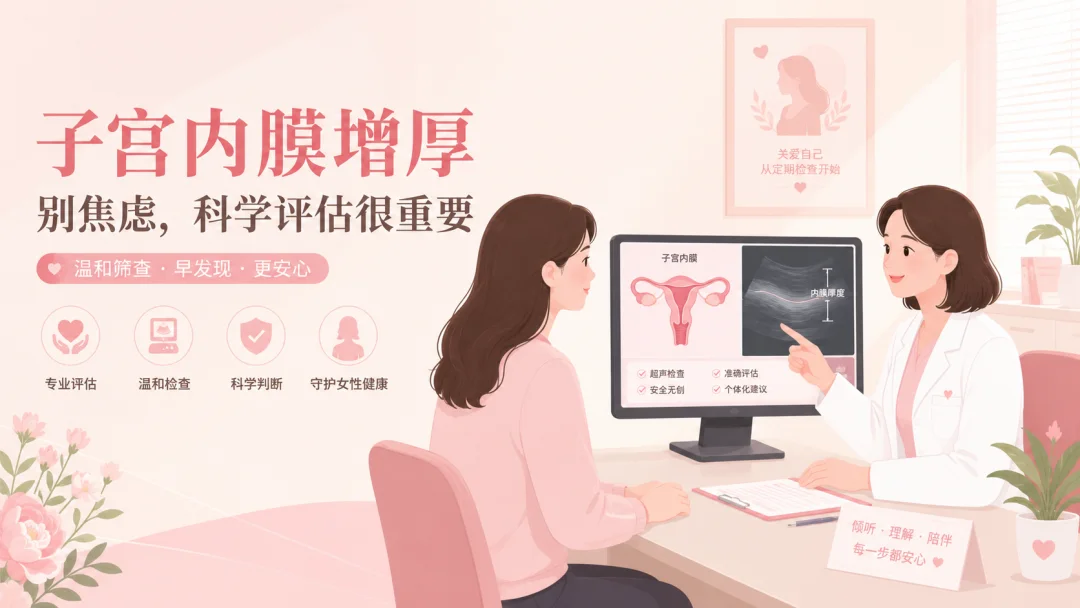
Many women feel anxious when a transvaginal ultrasound (TVS) report says “thickened endometrium” and a clinician recommends further evaluation. The word “hysteroscopy” can raise concerns about pain, anesthesia, and possible effects on future fertility.
An invasive procedure is not automatically the next step for everyone. Endometrial thickness is an imaging finding, not a cancer diagnosis. For people who need additional evaluation, clinicians are exploring a three-step pathway that moves from noninvasive assessment to targeted triage and, when indicated, definitive evaluation.
I. What is the three-step pathway for endometrial cancer evaluation?
The approach follows the familiar screening principle of “screen first, triage next, confirm when needed”:
- Step 1: Transvaginal ultrasound (TVS). This widely used first-line examination assesses endometrial thickness, echogenicity, and local morphology.
- Step 2: Minimally invasive sampling or molecular marker testing. An outpatient sample or molecular test may provide additional risk information before an invasive uterine procedure is considered.
- Step 3: Hysteroscopy with endometrial biopsy. When imaging and triage suggest higher risk, a clinician may recommend hysteroscopy and pathology to establish a diagnosis.
This is not a one-size-fits-all sequence. Age, menstrual or menopausal status, symptoms, risk factors, and the results of earlier assessments all matter when a clinician designs the next step.
II. Why is ultrasound alone not enough?
TVS is convenient and broadly available, but it primarily evaluates anatomy and morphology. It cannot directly identify malignant changes at the cellular level. A low thickness threshold may still miss some early disease, while an overly strict threshold can classify many benign findings as high risk and lead to unnecessary procedures.
“Thickened endometrium” should therefore be interpreted together with the clinical picture rather than treated as an automatic indication for hysteroscopy. Abnormal uterine bleeding, postmenopausal bleeding, obesity, long-standing irregular menstruation, and a relevant family history should all be discussed with a gynecologist.
III. Molecular testing may provide a second triage step
DNA methylation testing looks for tumor-related molecular signals and adds information beyond morphology. Some tests use a cervical brush to collect exfoliated cells, similar to the sampling approach used in cervical screening, and then assess methylation patterns associated with endometrial cancer.
Within a clinical pathway, this can act as a buffer between ultrasound and hysteroscopy:
- A result suggesting lower risk may support follow-up or repeat assessment after a clinician’s review, helping avoid an immediately unnecessary uterine procedure.
- A result suggesting higher risk may help the clinician decide whether to arrange hysteroscopy and pathology more urgently.
Molecular testing does not replace pathology, and patients should not stop follow-up or delay care based on a result alone. The appropriate plan must be determined by a gynecologist who considers symptoms, ultrasound findings, menopausal status, and individual risk.
IV. Avoiding an unnecessary uterine procedure can also help protect fertility
Hysteroscopy and curettage are important diagnostic tools, but both are invasive. For women who still hope to conceive, repeated intrauterine procedures may increase the risk of endometrial injury or intrauterine adhesions. When clinically appropriate, gentler risk stratification can help reserve invasive evaluation for those most likely to benefit.
He Kou An® (CISENDO®) is CISPOLY’s DNA methylation testing product for endometrial cancer. The sampling process does not require cervical dilation or anesthesia and can generally be performed by trained healthcare professionals, providing molecular information to support noninvasive risk assessment.
V. Takeaway: assess first, then decide
If an ultrasound shows a thickened endometrium, there is no need to panic over a single number—but symptoms such as postmenopausal bleeding should never be ignored. A more appropriate approach is to first ask a clinician whether further evaluation is needed, then select the next step based on ultrasound findings, symptoms, and risk factors. Hysteroscopy and pathology should be completed promptly when indicated.
For people at higher risk, it is reasonable to ask whether noninvasive DNA methylation testing could be used as an interim triage tool before hysteroscopy. A precise, risk-based pathway aims to reduce unnecessary procedures while protecting health and, where relevant, fertility.
Source
Adapted from Three-Step Screening Strategy for Endometrial Cancer (Chinese Journal of Practical Gynecology and Obstetrics, 2026, 42(5): 494–498). The DNA methylation testing technology described here has been included in the group standard Technical Specification for Tumor DNA Methylation Biomarker Detection. Specific testing and clinical decisions should follow the advice of a qualified clinician.

Beijing Origin-Poly Co., Ltd. is a technology enterprise driven by innovation and committed to health. CISPOLY focuses on early diagnosis of gynecologic tumors and develops products for cervical, endometrial, and ovarian cancer based on proprietary technologies and patent-protected biomarkers.
As women’s health needs continue to evolve, CISPOLY will keep advancing early screening and early diagnosis products, together with new solutions across women’s health management.