New Publication | Breakthrough in Self-Collected Cervical Sampling for Endometrial Cancer Detection: Noninvasive CDO1/CELF4 Methylation Testing Achieves Accuracy Comparable to Physician Sampling
August 13, 2026, 14:00
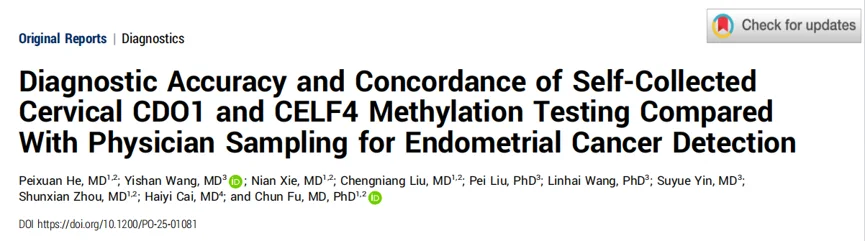
Recently, a research team from the Second Xiangya Hospital of Central South University published online in the internationally authoritative oncology journal JCO Precision Oncology (a JCO sub-journal) a research paper titled Diagnostic Accuracy and Concordance of Self-Collected Cervical CDO1 and CELF4 Methylation Testing Compared With Physician Sampling for Endometrial Cancer Detection. Addressing the clinical pain points of the continuously rising incidence of endometrial cancer and the lack of noninvasive, convenient early diagnostic methods, this study used pathological results as the gold standard to systematically evaluate the clinical feasibility of CDO1 and CELF4 gene methylation testing in self-collected vaginal/cervical samples, its concordance with physician sampling, and its diagnostic performance for endometrial cancer — providing direct evidence-based support for incorporating the self-sampling model into clinical pathways.
I. Research Background
The incidence of endometrial cancer has been continuously rising in recent years, with a tendency toward earlier onset age. Current clinical evaluation of suspected endometrial cancer mainly relies on pelvic examination, transvaginal ultrasound (TVS), and invasive hysteroscopy/endometrial biopsy. These approaches are limited by invasiveness or operator dependence, resulting in constrained patient compliance and occasional early missed diagnoses.
Previous studies have confirmed that CDO1 and CELF4 gene methylation testing in physician-collected cervical exfoliated cells has high diagnostic value for endometrial cancer. However, a key question had long remained insufficiently answered: can patient self-sampling achieve testing quality and pathology-correlated diagnostic performance comparable to physician sampling?
II. Methods
This prospective cross-sectional study enrolled women undergoing hysteroscopy for abnormal uterine bleeding, abnormal TVS findings, or other clinical indications. Each participant completed paired dual sampling simultaneously:
self-collected vaginal/cervical samples and physician-collected cervical exfoliated cell samples for methylation testing, using hysteroscopic biopsy pathology as the gold standard to compare the concordance between the two sampling methods and their diagnostic performance for endometrial cancer.
III. Key Findings
🔬 Biomarker discrimination ability
Regardless of self-sampling or physician sampling, CDO1/CELF4 methylation levels in the endometrial cancer group were significantly higher than in the non-cancer group, confirming that these two biomarkers can stably distinguish endometrial cancer from benign lesions in self-collected samples as well.
🤝 Sampling concordance
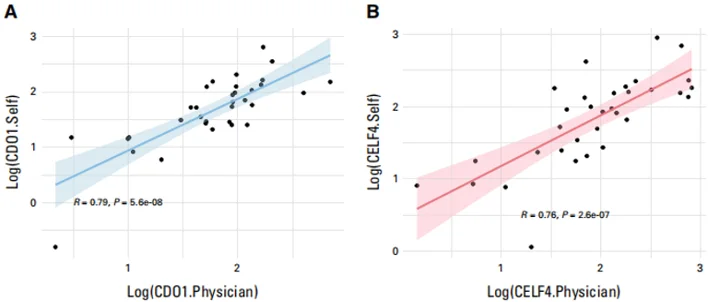
Methylation values from self-sampling and physician sampling were highly correlated — the correlation coefficients for both CDO1 and CELF4 reached statistical significance, indicating that self-sampling has good concordance with physician sampling at the molecular detection level for endometrial cancer.
📊 Diagnostic performance (self-sampling)
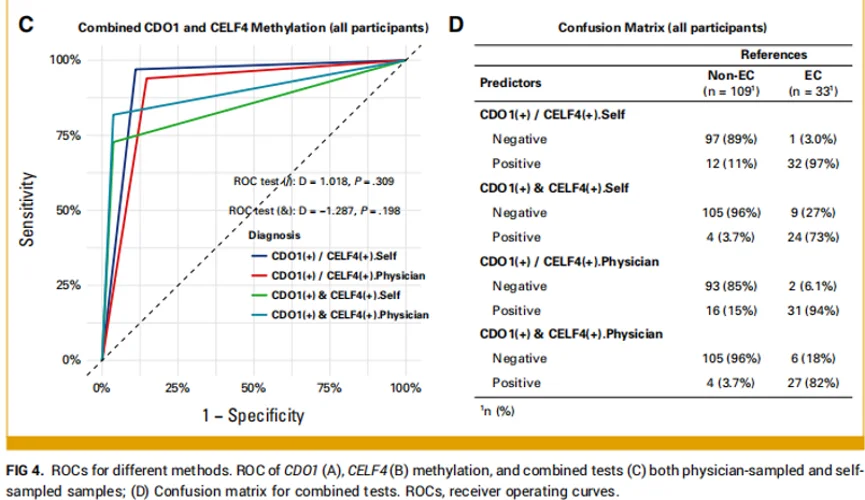
The combined CDO1/CELF4 test achieved an AUC of 0.930, and maintained high diagnostic performance in both premenopausal and postmenopausal populations, with applicability not limited to a single subgroup.
IV. Clinical Value
The core contribution of this study is that it not only proves self-sampling is "feasible," but also confirms it has diagnostic efficacy comparable to physician sampling. For women with abnormal uterine bleeding, abnormal TVS findings, or a need to assess endometrial lesion risk, self-sampling provides a more convenient, comfortable, and private option.
Its potential advantages manifest at four levels:
·Accessibility: Reducing dependence on on-site sampling at medical institutions, benefiting people in remote areas, areas with insufficient medical resources, and those with difficulty accessing care;
·Compliance: Noninvasive and self-completed, reducing embarrassment and discomfort, improving patient acceptance;
·Triage value: Can serve as a risk-stratification tool before TVS/hysteroscopy/biopsy, optimizing clinical decisions and improving early detection rates;
·Telemedicine adaptability: Self-collected CDO1/CELF4 methylation testing facilitates follow-up and self-management of high-risk populations, supporting remote risk-stratification results after home sampling.
V. Future Clinical Application Outlook
If self-collected CDO1/CELF4 methylation testing is further validated in subsequent multicenter, large-sample cohorts, it may gradually be embedded into multiple clinical pathways:
①As a first-line triage tool in outpatient clinics for abnormal uterine bleeding — combining methylation with imaging for joint assessment; those with both negative results can be followed up at community/primary care level, while those with either positive result are referred for hysteroscopy, effectively alleviating the pressure on hysteroscopy resources at tertiary hospitals;
②Extending to early screening scenarios for asymptomatic postmenopausal high-risk populations (obesity, Lynch syndrome, long-term estrogen exposure), filling the current gap of insufficient TVS specificity;
③Combining with liquid biopsy and hysteroscopy AI imaging to form multimodal EC risk assessment models;
④In primary care and telemedicine scenarios, building a closed-loop management model of "home self-sampling — mailed testing — cloud reports — clinical intervention," truly enabling EC early diagnosis and long-term follow-up of high-risk populations to be delivered at the grassroots level.
As the study emphasizes: "Ultrasound sees morphology, methylation sees molecules, and together they prevent missed diagnosis." Combining noninvasive morphological examination (TVS) with molecular testing (methylation) is expected to build a more comprehensive and precise grassroots screening system for endometrial cancer, minimizing the risk of missed diagnosis.
VI. Summary
This study demonstrates that self-collected cervical/vaginal samples for CDO1/CELF4 methylation analysis, as a reliable, noninvasive, patient-centered strategy, have important application value in telemedicine and resource-limited settings, and are expected to play a substantive role in early detection, risk stratification, and diagnostic pathway optimization of endometrial cancer.
Reference
He P, Wang Y, Xie N, et al. Diagnostic Accuracy and Concordance of Self-Collected Cervical CDO1 and CELF4 Methylation Testing Compared With Physician Sampling for Endometrial Cancer Detection[J]. JCO Precision Oncology, 2026, 10: e2501081.

Beijing Origin-Poly Co., Ltd. is a technology enterprise driven by innovation and dedicated to health. As a pioneer in early diagnosis of gynecologic tumors, CISPOLY has developed early-diagnosis products for cervical, endometrial, and ovarian cancers using proprietary technologies and patent-protected biomarkers, filling a gap in the field. As women pay increasing attention to their own health, the women's health market holds great potential. Beyond the gynecologic tumor early screening and early diagnosis product line, CISPOLY will continue to build more women's health-related product pipelines, establishing itself as a technology-innovative leading enterprise in the women's health market.