Beyond Potential HPV Over-Referral: Combining PAX1/JAM3 Methylation with HPV to Identify High-Grade Cervical Lesion Risk
September 3, 2026, 13:37
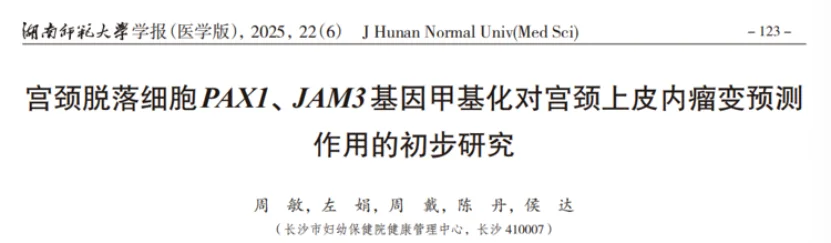
A team from the Health Management Center of Changsha Maternal and Child Health Hospital published a preliminary study in the Journal of Hunan Normal University (Medical Sciences). The study evaluated PAX1 and JAM3 methylation in cervical exfoliated cells as combined biomarkers for high-grade cervical intraepithelial neoplasia and explored their value when combined with HPV typing.
I. From detecting infection to identifying risk
PAX1 and JAM3 are host genes associated with cervical carcinogenesis. Persistent high-risk HPV infection may induce abnormal methylation in tumor-suppressor gene promoters, silence gene expression, and contribute to progression from precancerous lesions to invasive cancer. By capturing signals related to abnormal cell proliferation and disruption of the epithelial barrier, combined PAX1/JAM3 testing may complement HPV testing, which cannot by itself reliably distinguish transient infection from infection with a higher progression risk.
II. A combined strategy provides a clearer triage signal
The study developed a strategy combining HPV typing with dual-gene methylation. Among high-risk HPV-positive participants, the presence of methylation in either PAX1 or JAM3 produced an AUC of 0.8789 for predicting CIN2 or worse, compared with 0.8310 for PAX1 alone, 0.7915 for JAM3 alone, and 0.4858 for HPV typing alone.
The combined strategy achieved 94.44% accuracy, 96.88% specificity, and an F1 score of 0.8594. These findings suggest that in settings such as ASC-US, where cytology is difficult to interpret, molecular testing may help identify people at genuinely higher risk and reduce referrals driven by HPV positivity alone.
III. What does this mean for clinical management?
PAX1/JAM3 methylation testing uses cervical exfoliated cells and is relatively non-invasive. Combined with HPV typing, it may identify individuals who have already developed host-cell epigenetic changes and provide more objective support for colposcopy referral, follow-up intervals, and subsequent treatment decisions. In primary-care screening, the combined “viral infection plus host risk” perspective may also help prioritize limited diagnostic resources for people more likely to have high-grade lesions.
The study supports risk stratification and decision support; it does not replace colposcopy or pathological diagnosis. Final management should integrate HPV genotype, cytology, medical history, and pathological evidence under a clinician’s guidance.
Combining PAX1/JAM3 methylation with HPV represents an important direction in cervical cancer screening: moving from asking whether a virus is present to asking whether host cells show signs of progression risk.
Publication source
Zhou M, Zuo J, Zhou D, Chen D, Hou D. Preliminary study on PAX1 and JAM3 gene methylation in cervical exfoliated cells for predicting cervical intraepithelial neoplasia. Journal of Hunan Normal University (Medical Sciences). 2025;22(6):123–128.

Beijing Origin-Poly Co., Ltd. is a technology enterprise driven by innovation and committed to health. CISPOLY focuses on early diagnosis of gynecologic tumors and develops products for cervical, endometrial, and ovarian cancer based on proprietary technologies and patent-protected biomarkers.
Going forward, CISPOLY will continue developing early screening and early diagnosis products, together with new women’s health solutions, to bring sustained technological innovation to women’s health.