New Publication | Solving the Postmenopausal Screening Dilemma: International Peer Review of PAX1/JAM3 Methylation for Optimizing High-Grade Cervical Lesion Screening
A study on improving diagnostic accuracy of high-grade cervical lesions in postmenopausal women using PAX1/JAM3 methylation detection, published in the International Journal of Cancer, has attracted attention from the international medical and academic communities. This study addresses the challenge of cervical cancer screening in postmenopausal women—a difficult-to-screen population—providing new precision diagnostic insights and methods.
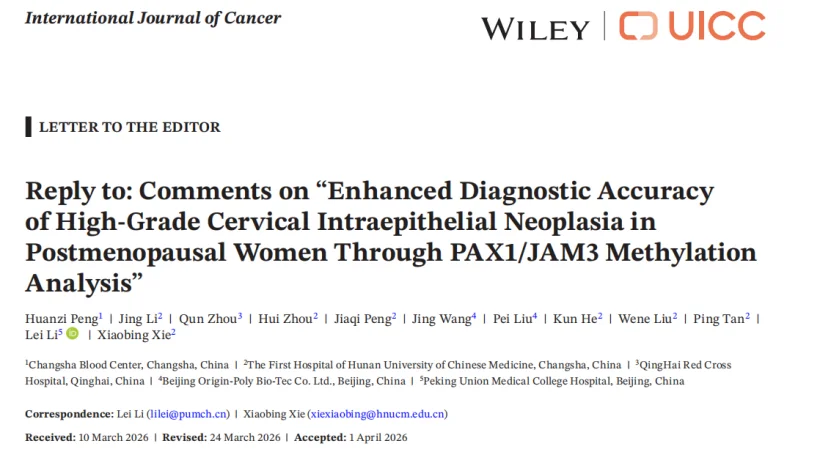
Academic Dialogue Elevates Research Value
Following publication, Fariha Shahid Tanveer and colleagues provided constructive comments on the study design, applicability, and translational value. The research team subsequently provided a formal response in the journal, forming a high-quality "comment–response–re-publication" academic dialogue. After re-review by invited journal reviewers, the response received unanimous approval, further strengthening the academic value and impact of the original study.
This in-depth academic exchange not only enhanced the scientific rigor of the original study but also provided a more solid theoretical foundation for clinical application of the related technology. Key highlights are summarized below:
I. An Innovative Solution for the Screening Challenge in Postmenopausal Women
Postmenopausal women experience cervical atrophy and inward migration of the transformation zone due to declining estrogen levels, often presenting as Type III transformation zones. This makes it difficult for cervical cytology (TCT) sampling brushes to effectively reach lesion-prone areas, leading to unsatisfactory sample adequacy and increased risk of false-negative results. Concurrently, cervical atrophy and vaginal narrowing also increase the difficulty of colposcopic examination, resulting in insufficient observation and challenging biopsy, which in turn leads to missed diagnoses of high-grade lesions. International peers noted that these factors collectively make postmenopausal women a particularly challenging population for cervical cancer screening.
The research team fully acknowledged these points and validated them through data analysis, emphasizing that this clinical challenge was precisely the key motivation behind the PAX1/JAM3 methylation detection study. The study demonstrated that PAX1/JAM3 methylation detection (CISCER) based on the RT-PCR technology platform does not depend on direct morphological observation or visibility of the transformation zone. Its detection targets are lesion-associated specific DNA methylation biomarkers in cervical exfoliated cells. Therefore, even for Type III transformation zone lesions hidden deep within the cervical canal—difficult to sample with traditional brushing methods—this approach can achieve more stable and precise identification through detection of these molecular biomarkers, providing a novel solution for postmenopausal women where traditional methods are limited.
II. Validating Diagnostic Value Through Pathological Endpoints
Addressing the limitations of cross-sectional studies, the research team clarified that their conclusions were strictly anchored to pathological endpoints, including colposcopy-guided biopsy, endocervical curettage, and excision specimens when necessary. Study data showed that PAX1/JAM3 methylation detection demonstrated high sensitivity and specificity for CIN2+ lesions in women aged 50 and older, and could identify lesions potentially missed by traditional HPV testing and cytology, including hrHPV-negative, cytology-negative adenocarcinoma cases.
These findings provide important evidence for improving current cervical cancer screening strategies for postmenopausal women.
III. From International Discussion to Clinical Translation
This academic dialogue not only addressed questions from international peers but also further clarified the clinical positioning of PAX1/JAM3 methylation detection in the diagnostic workflow for high-grade cervical lesions in postmenopausal women.
The research team indicated that future multicenter, prospective population screening cohorts, along with cost-effectiveness and laboratory consistency studies, will further validate the technology's application value across different healthcare systems, providing more reliable precision approaches for early diagnosis and treatment of cervical cancer in postmenopausal women.
The success of this international academic dialogue highlights the growing voice and contribution of Chinese research in international cancer prevention and treatment, and provides new pathways for further improving women's health.
Reference:
Peng, H., Li, J., Zhou, Q., Zhou, H., Peng, J., Wang, J., Liu, P., He, K., Liu, W., Tan, P., Li, L., & Xie, X. (2026). Reply to: Comments on "Enhanced Diagnostic Accuracy of High-Grade Cervical Intraepithelial Neoplasia in Postmenopausal Women Through PAX1/JAM3 Methylation Analysis". International Journal of Cancer, 10.1002/ijc.70484. https://doi.org/10.1002/ijc.70484

Beijing Origin-Poly Co., Ltd. is a technology enterprise driven by innovation and committed to health. As a pioneer in the field of early diagnosis of gynecologic tumors, CISPOLY has developed early detection products for cervical cancer, endometrial cancer, ovarian cancer and other gynecologic malignancies based on proprietary technologies and patent-protected biomarkers, filling gaps in this field.
As women's awareness of their own health continues to grow, the women's health market holds tremendous potential. Beyond the gynecologic tumor early screening and diagnosis product line, CISPOLY will continue to establish additional women's health-related product pipelines, striving to become a technology innovation leader in the women's health market.