New Publication | PAX1/JAM3 Dual-Gene Methylation Testing Enables Precision Management of High-Grade Lesions in High-Risk HPV-Positive Individuals
Recently, a research team from the Department of Laboratory Medicine at Ziyang Central Hospital published a study titled "Utility of PAX1/JAM3 methylation analysis for triage of high-risk HPV-positive individuals" in the Oxford University Press journal Laboratory Medicine. This study focuses on the clinical pain point of how to more precisely triage high-risk HPV-positive populations, systematically evaluating the application value of PAX1/JAM3 dual-gene methylation detection in identifying high-grade cervical lesions and optimizing colposcopy referral strategies, aiming to provide a more objective and efficient new tool for precision management after cervical cancer screening.
I. Background and Methods
High-risk HPV serves as a highly sensitive primary screen for cervical cancer, but a positive result does not equate to the presence of high-grade lesions—instead causing patient anxiety and unnecessary medical visits. Traditional cytology triage is affected by subjective interpretation, sample quality, and personnel experience, leading to the coexistence of over-referral and missed diagnoses in clinical practice.
To identify more objective and stable triage biomarkers, this study enrolled 312 high-risk HPV-positive individuals, detecting PAX1/JAM3 dual-gene methylation levels in cervical secretions, with histopathological results as the gold standard, to evaluate performance in identifying CIN2+ lesions and optimizing colposcopy referral efficiency.
II. Key Results
- PAX1/JAM3 methylation detection demonstrates independent triage capability
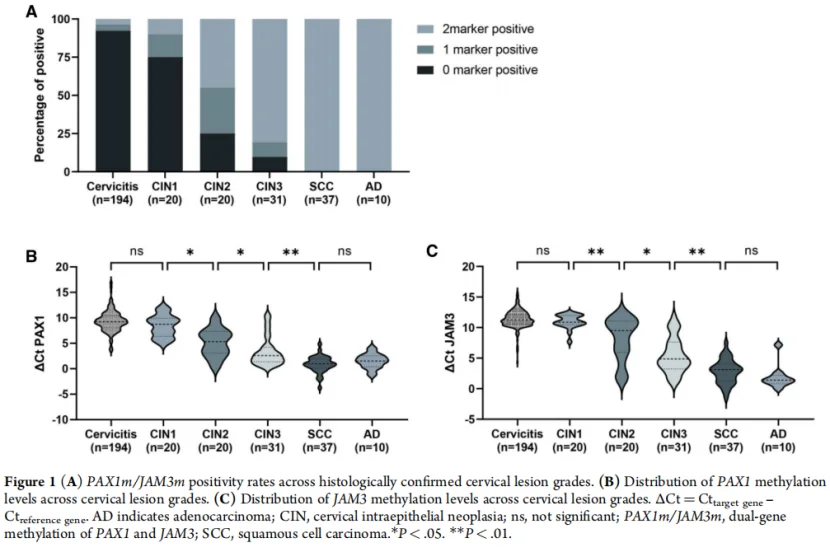
The study showed that PAX1 and JAM3 methylation positivity rates increased significantly with increasing severity of cervical lesions, suggesting close correlation with disease progression; in cervical cancer cases, both achieved 100% detection.
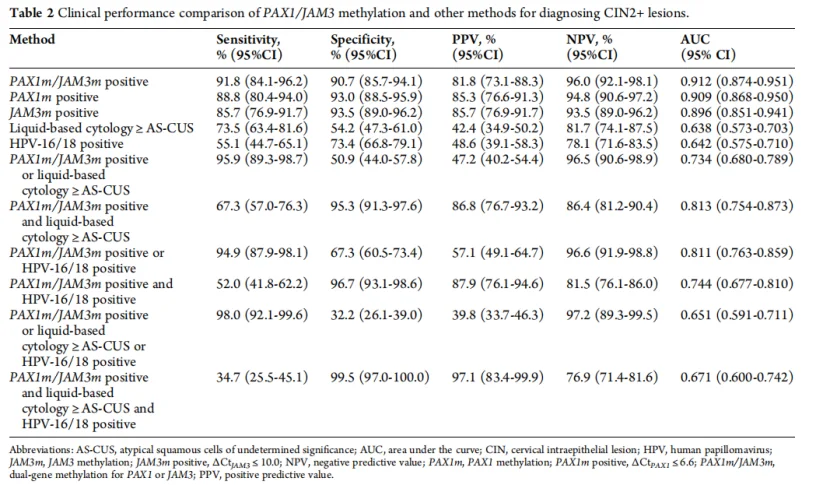
- In CIN2+ detection, PAX1/JAM3 dual-gene methylation demonstrated excellent performance:
Sensitivity 91.8%, specificity 90.7%, positive predictive value 81.8%, negative predictive value 96.0%, AUC 0.912, overall superior to traditional cytology (≥ASC-US) and HPV16/18 genotyping. The study also found that while combined testing could further improve sensitivity to some extent, it often significantly sacrificed specificity and positive predictive value, with no clinically meaningful improvement in AUC, indicating that PAX1/JAM3 methylation detection alone already possesses strong independent triage capability.
- PAX1/JAM3 methylation precisely reduces colposcopy referral rates
Using PAX1/JAM3 methylation positivity as the referral criterion, among all high-risk HPV-positive individuals, an average of 1.22 referrals were needed to detect 1 CIN2+ lesion. Compared to liquid-based cytology ≥ASC-US, this strategy reduced colposcopy referral rates from 54.5% to 35.3%, equivalent to a reduction of approximately 19.2% in unnecessary referrals, while increasing CIN2+ detection rate from 42.4% to 81.8%, a 39.4% improvement in detection efficiency.
In the particularly challenging "non-HPV16/18 other 12 high-risk HPV-positive" population, compared to liquid-based cytology, PAX1/JAM3 methylation detection reduced colposcopy referral rates from 60.2% to 25.9%, a decrease of approximately 34.3%, while increasing CIN2+ detection rate from 30.6% to 75.0%, an improvement of 44.4%.
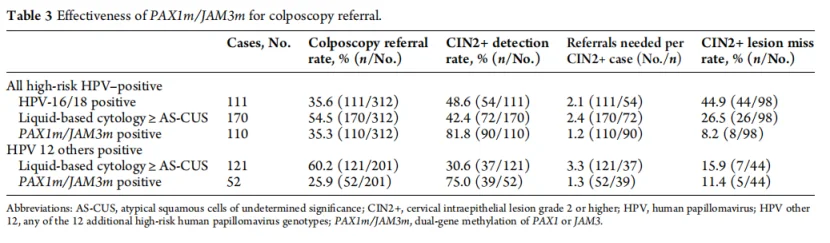
These results demonstrate that PAX1/JAM3 methylation detection is valuable not only for triage in general high-risk HPV-positive populations but also in subgroups where risk assessment has traditionally been more difficult.
III. Clinical Value
The core advantages of PAX1/JAM3 dual-gene methylation detection lie in being "more objective, more stable, and more efficient." Unlike cytology, which relies on human interpretation, methylation detection is an objective molecular-level indicator with better reproducibility and less susceptibility to operator experience—particularly suitable for promotion in regions with uneven cytology capabilities or relatively limited resources.
From a management pathway perspective, this detection can help clinicians more precisely determine "who needs prompt colposcopy and who can avoid unnecessary referral," thereby reducing over-investigation, alleviating patient anxiety and healthcare resource consumption. Its application is expected to reduce over-referral, lower patient psychological burden and medical costs, and drive post-screening management from "empirical triage" toward "molecular precision triage."
Particularly in grassroots settings or regions with uneven cytology capabilities, this molecular biomarker strategy has even greater practical promotion significance.
IV. Conclusion
Overall, this study demonstrates: PAX1/JAM3 dual-gene methylation detection can effectively identify high-grade cervical lesions in high-risk HPV-positive populations and significantly optimize colposcopy referral strategies. Its outstanding performance in sensitivity, specificity, and overall discriminative ability demonstrates its potential as an independent triage tool. With accumulating evidence, PAX1/JAM3 methylation detection is poised to become an important component of precision management after cervical cancer screening, providing clinicians with more precise and efficient decision support.
Guo Q, Wang H, Diao X, et al. Utility of PAX1/JAM3 methylation analysis for triage of high-risk HPV-positive individuals. Lab Med. 2026;57(2):lmaf096. doi:10.1093/labmed/lmaf096

Beijing Origin-Poly Co., Ltd. is a technology enterprise driven by innovation and committed to health. As a pioneer in the field of early diagnosis of gynecologic tumors, CISPOLY has developed early detection products for cervical cancer, endometrial cancer, ovarian cancer and other gynecologic malignancies based on proprietary technologies and patent-protected biomarkers, filling gaps in this field.
As women's awareness of their own health continues to grow, the women's health market holds tremendous potential. Beyond the gynecologic tumor early screening and diagnosis product line, CISPOLY will continue to establish additional women's health-related product pipelines, striving to become a technology innovation leader in the women's health market.