JAM3 Methylation Positivity Predicts High-Grade Lesion Risk in Women with Abnormal Cervical Cancer Screening Results
October 14, 2026, 09:54 (China Standard Time)
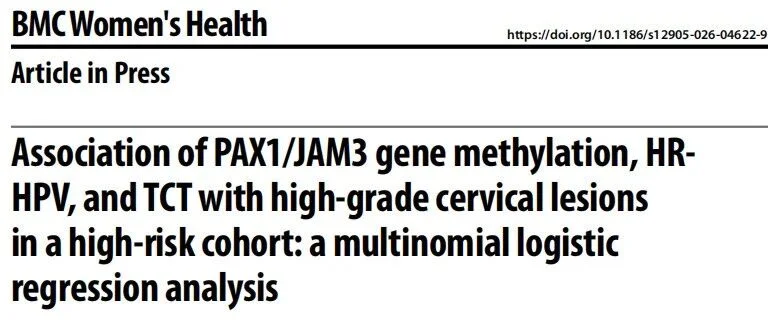
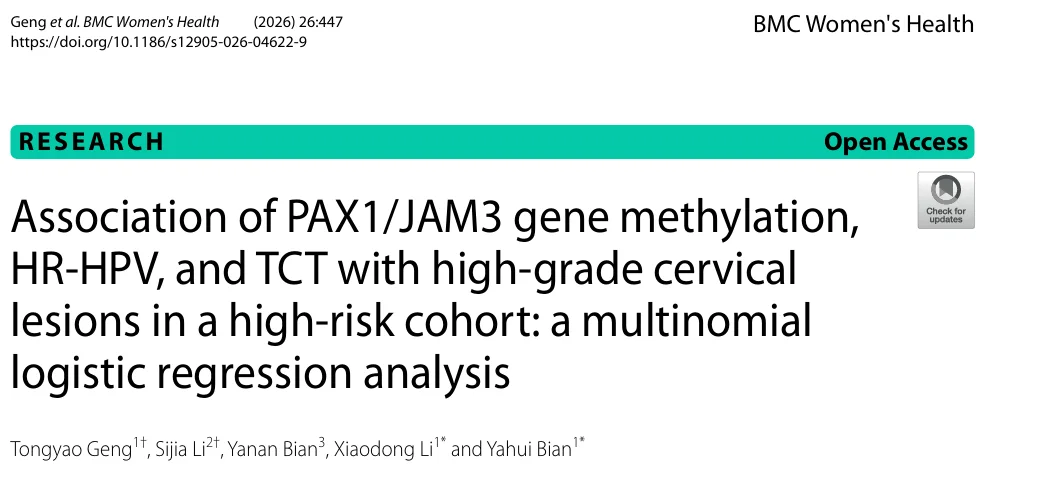
The gynecology team of the First Hospital of Hebei Medical University published a research paper in the international journal BMC Women's Health, entitled "Association of PAX1/JAM3 gene methylation, HR-HPV, and TCT with high-grade cervical lesions in a high-risk cohort: a multinomial logistic regression analysis." The study focused on high-risk women referred to colposcopy because of abnormal screening results, systematically analyzing the relationships between high-risk human papillomavirus (HR-HPV), liquid-based cytology (TCT), and PAX1/JAM3 gene methylation across grades of cervical lesions, with the aim of identifying risk-stratification markers that recognize high-grade lesions more accurately.
I. Methylation testing identifies women at high lesion risk among those with abnormal screening results
HR-HPV testing is highly sensitive, but most infections are transient, and HPV positivity alone tends to increase colposcopy referrals. TCT depends on trained professionals and equipment, and in some cases it cannot accurately judge lesion risk. After an abnormal conventional screening result, how to further identify women who truly have "high-grade cervical lesions" and avoid missed diagnoses at colposcopy or biopsy remains an important issue in cervical cancer prevention and control.
The study team enrolled and analyzed a cohort with abnormal cervical cancer screening or test results: abnormal TCT, HR-HPV infection, or PAX1/JAM3 methylation positivity. Using multinomial logistic regression, the researchers analyzed the independent risk factors for LSIL and HSIL separately, avoiding the assumption that lesions at different stages represent a single linear progression— a notable strength of the statistical design.
II. Highlight 1: JAM3 methylation carries a higher risk estimate
Multivariable analysis found that, compared with the inflammation group, HPV16/18 infection increased the odds of HSIL by 6.801-fold and abnormal TCT corresponded to a 2.399-fold risk. More notably, PAX1 methylation positivity was associated with a 4.145-fold increase in HSIL odds, while JAM3 methylation positivity corresponded to an 8.215-fold risk; both were independent associated factors.
Dual-gene methylation may not simply indicate "any cervical abnormality," but rather tends to identify lesions that have already progressed to the high-grade stage.
III. Highlight 2: JAM3 methylation positivity shows a strong association with HSIL
HPV16/18 reflects exposure to an oncogenic virus, TCT reflects cellular morphological abnormalities, while PAX1/JAM3 methylation provides information on epigenetic changes in host cells. The three indicators complement one another across different biological levels. In particular, JAM3 showed a strong association with HSIL, providing new molecular evidence for the clinical observation that "HPV-positive women do not all carry the same lesion risk."
IV. Clinical value: a triage tool after abnormal screening
The research team emphasized that PAX1/JAM3 methylation is currently better suited as a triage and risk-stratification tool after abnormal HPV or TCT results. For populations already referred to colposcopy, incorporating dual-gene methylation results into comprehensive assessment may help physicians prioritize patients at high risk of HSIL and prompt timely biopsy and intervention; for those at relatively low risk, it may reduce unnecessary excess examination and treatment.
These findings come from a single high-risk cohort study. Methylation results should still be interpreted together with HPV genotyping, cytology, colposcopy, and histopathology, and cannot replace clinical or pathological diagnosis.
Reference
Geng T., Li S., Bian Y. et al. Association of PAX1/JAM3 gene methylation, HR-HPV, and TCT with high-grade cervical lesions in a high-risk cohort: a multinomial logistic regression analysis. BMC Women's Health (2026). DOI: 10.1186/s12905-026-04622-9
Original article

Beijing OriginPoly Bio-Tec Co., Ltd. is a technology company driven by innovation and dedicated to health. CISPOLY is a pioneer in the early diagnosis of gynecological cancers and develops products for early detection of cervical, endometrial, and ovarian cancer based on proprietary technologies and patent-protected biomarkers, filling a gap in this field.
As women pay closer attention to their own health, the women's health market holds great promise. In addition to its early screening and diagnosis product line for gynecological cancers, CISPOLY will continue to build additional women's health product pipelines, striving to become a technology-driven leader in the women's health market.