Guidelines/Consensus | World's First Expert Consensus on Clinical Application of Methylation in Endometrial Cancer Released — CISPOLY CISENDO® Resolves the 'Gold Standard' Compliance Challenge [Series Report I]
The Expert Consensus on Clinical Application of Gene Methylation Screening Technology for Endometrial Cancer (2026 Edition) (hereinafter referred to as the "Consensus"), jointly led by the Chinese Society of Gynecologic Oncology under the Chinese Medical Association, the Obstetrics and Gynecology Committee of the Chinese Hospital Research Association, and the Obstetrics and Gynecology Health Medical Branch of the China International Exchange and Promotive Association for Health Care, and co-authored by authoritative experts from top gynecologic oncology centers including Peking Union Medical College Hospital, Peking University People's Hospital, Qilu Hospital of Shandong University, Tongji Hospital of Tongji Medical College of Huazhong University of Science and Technology, and West China Second University Hospital of Sichuan University, has been officially published in the Chinese Medical Journal.
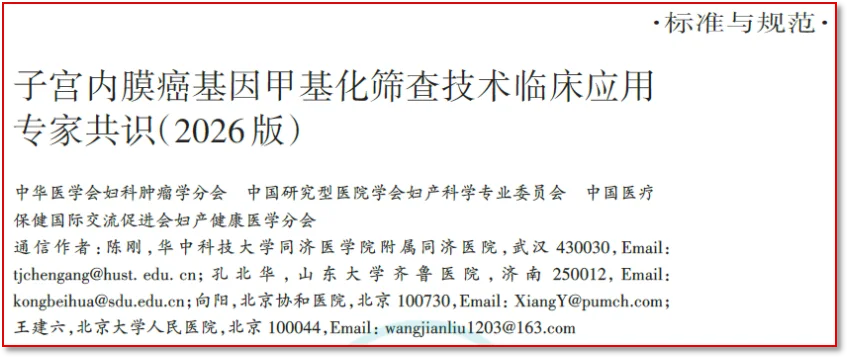
This is the world's first expert consensus dedicated to the clinical application of gene methylation screening technology for endometrial cancer, marking the official transition of endometrial cancer prevention and control into the era of "minimally invasive, precision-based, and individualized" early screening. Notably, prior to the release of this consensus, the "Human CDO1 and CELF4 Gene Methylation Detection Kit (CISENDO®)" independently developed by Beijing Origin-Poly Co., Ltd. had already obtained the Class III Medical Device Registration Certificate (National Medical Device Registration No. 20243402610) from the National Medical Products Administration (NMPA) in December 2024, becoming one of the first domestically approved methylation detection products for endometrial cancer, providing a compliant and highly effective tool for the "selective screening" strategy recommended by the consensus.
I. Groundbreaking Significance: Filling an International Gap and Establishing a "Selective Screening" Pathway
Endometrial cancer is a gynecologic malignancy with a continuously rising incidence rate worldwide and an increasing trend toward younger populations. According to the Chinese Clinical Practice Guidelines for Gynecologic Tumors, screening should be conducted for three categories of populations: "symptomatic populations, populations with increased risk, and high-risk populations."
The consensus states: "In 2025, gene methylation detection technology for endometrial cancer was officially approved by the NMPA for marketing and clinical application. As a new molecular detection method, this technology can timely identify early-stage endometrial cancer risk, effectively filling the technical gap in 'clinical non-invasive screening' in this field." The release of this consensus aims to standardize the application workflow of methylation detection technology across these three population categories, enabling precise triage and improving patient prognosis.
II. Dilemmas of Traditional Screening: The "Trauma" of the Gold Standard and the "False Alarms" of Ultrasound
The consensus systematically reviewed the pain points of existing screening technologies, highlighting the urgency of introducing new technologies:
(1) Limitations of the Pathological Gold Standard: "Currently, hysteroscopy-guided targeted biopsy or hysteroscopy combined with fractional dilation and curettage (D&C) for endometrial tissue pathological examination is clinically recommended as the 'gold standard' for diagnosing endometrial cancer." However, "diagnostic D&C may miss up to 60% of endometrial lesions. Moreover, this method is an invasive procedure with poor short-term repeatability and carries risks of uterine perforation, hemorrhage, infection, and injury to surrounding organs, making it unsuitable as a routine screening method."
(2) Challenges of Micro-tissue Sampling: Although endometrial micro-tissue pathological examination offers advantages such as minimal invasiveness and no need for anesthesia, "how to improve the sampling adequacy rate, particularly for postmenopausal patients or those with insufficient endometrial thickness, remains an urgent challenge to address."
(3) High Miss rate of Ultrasound: "Although ultrasound examination has high sensitivity, it suffers from low specificity, low positive predictive value, and high false-positive rates. Therefore, ultrasound is primarily used for preliminary screening of endometrial cancer in postmenopausal women, rather than as the primary standalone screening method."
III. CISPOLY CISENDO®: Delivering Outstanding Performance for Clinical Non-invasive Detection
Addressing these clinical pain points, the consensus explicitly states: "Currently, the technologies available for clinical endometrial cancer screening mainly include ultrasound examination, pathological examination, and gene methylation detection technology."
CISENDO® (Human CDO1 and CELF4 Gene Methylation Detection Kit) has become an important technological tool recommended by the consensus due to its outstanding performance. According to product clinical trial data, CISENDO® achieves a clinical sensitivity of 94.51% and a specificity of 94.16%. The product uses cervical exfoliated cell sampling, which is completely identical to the sampling pathway of routine HPV testing, achieving the true non-invasive detection advocated by the expert consensus.
Consensus experts specifically emphasized: "In clinical practice, methylation detection can be combined with the most commonly used clinical ultrasound examination to achieve precise management of symptomatic populations, populations with increased risk, and high-risk populations, reducing endometrial damage and patient financial burden caused by excessive intrauterine procedures." As the first (batch of) product(s) to obtain certification in China in 2024, CISENDO® will assume a critical role in non-invasive screening and triage within this clinical pathway.
IV. Consensus Core: Four Major Clinical Advantages of Methylation Technology
Based on the consensus content, gene methylation detection technology (represented by NMPA-approved CISENDO®) offers the following significant advantages over traditional methods:
-
Minimally invasive sampling with high compliance: Cervical brush collection of exfoliated cells requires no cervical dilation or anesthesia, significantly reducing patient discomfort and resolving the poor compliance issues associated with traditional D&C and hysteroscopy.
-
Precise triage, avoiding "overtreatment": High specificity (94.16%) effectively reduces unnecessary invasive surgeries caused by ultrasound false positives; high sensitivity (94.51%) ensures detection rates in high-risk populations.
-
Broad applicability, especially suitable for "difficult-to-sample" populations: For patients with traditional sampling difficulties such as thin postmenopausal endometrium or cervical canal stenosis, cervical exfoliated cell sampling offers unique advantages.
-
Facilitating the implementation of "selective screening": It provides a practical screening tool for the three categories of high-risk populations recommended by the Chinese Clinical Practice Guidelines for Gynecologic Tumors, and is a key component in achieving early diagnosis and treatment of endometrial cancer.
With the implementation of the 2026 edition consensus, CISPOLY will collaborate with major clinical centers across China to jointly promote the paradigm shift of endometrial cancer screening from "invasive triage" to "non-invasive management," effectively protecting women's fertility and quality of life.
Reference
Chinese Society of Gynecologic Oncology, Chinese Medical Association; Obstetrics and Gynecology Committee, Chinese Hospital Research Association; Obstetrics and Gynecology Health Medical Branch, China International Exchange and Promotive Association for Health Care. Expert consensus on clinical application of gene methylation screening technology for endometrial cancer (2026 edition). Chinese Medical Journal, 2026, 106(26): 2701–2710. DOI: 10.3760/cma.j.cn112137-20260301-00576

Beijing Origin-Poly Co., Ltd. is a technology enterprise driven by innovation and committed to health. As a pioneer in the field of early diagnosis of gynecologic tumors, CISPOLY has developed early detection products for cervical cancer, endometrial cancer, ovarian cancer and other gynecologic malignancies based on proprietary technologies and patent-protected biomarkers, filling gaps in this field.
As women's awareness of their own health continues to grow, the women's health market holds tremendous potential. Beyond the gynecologic tumor early screening and diagnosis product line, CISPOLY will continue to establish additional women's health-related product pipelines, striving to become a technology innovation leader in the women's health market.