Expert Consensus | China Releases New CIN2 Management Expert Consensus, First Emphasizing 'Gene Methylation Testing' as the Basis for Precision Management, Ushering in a New Era of Cervical Precancerous Lesion Management
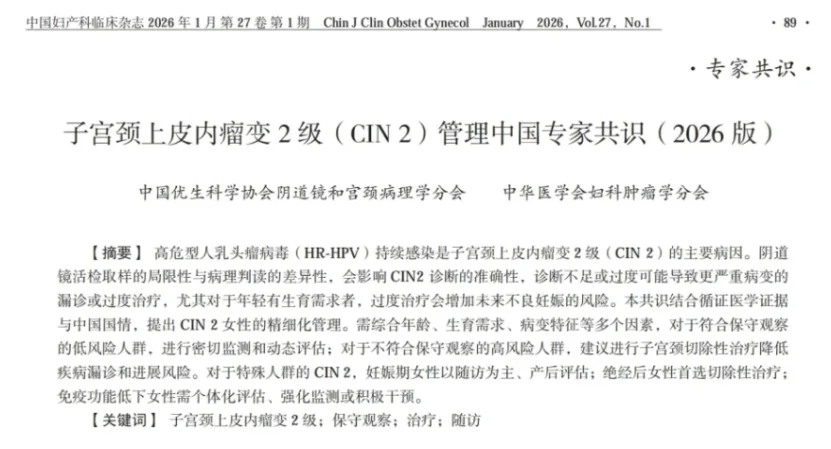
The highly anticipated Chinese Expert Consensus on Management of Cervical Intraepithelial Neoplasia Grade 2 (CIN2) (2026 Edition) (hereinafter referred to as the "Consensus"), released by the Colposcopy and Cervical Pathology Branch of the Chinese Society for Eugenics (CSCCP), has been officially published. Multiple studies over the past decade have shown that CIN2 has a high spontaneous regression rate within 24 months, particularly in women under 30, with risk of progression to invasive cancer below 0.5%. However, with longer-term conservative observation, the risk of CIN2 progressing to invasive cancer rises again. Therefore, achieving precision management in CIN2—particularly regarding indications, monitoring, and follow-up decisions for conservative observation versus treatment, and management of CIN2 in special populations—remains a pressing clinical challenge.
I. Breaking Tradition: Driving Clinical CIN2 Management from "One-Size-Fits-All" to "Precision Management"
Traditionally, biopsy-confirmed CIN2 was typically managed with direct excisional surgery. However, substantial evidence shows that particularly for women under 30, the risk of CIN2 progression to cancer is extremely low (<0.5%). Blind "one-size-fits-all" surgery causes unnecessary cervical damage, especially in young women with fertility desires, and also constitutes a waste of medical resources.
Women with colposcopy biopsy-confirmed CIN2 should be precisely stratified into two categories:
-
High-risk population (with missed CIN3+ or higher risk of CIN2 persistence or progression to CIN3+): Can benefit from cervical excisional treatment for definitive diagnosis and therapeutic benefit.
-
Low-risk population (with lower risk of the above): Conservative observation may be adopted through close monitoring and dynamic assessment, maximizing avoidance of immediate invasive treatment. Assessment factors include: patient age, fertility desires, cervical cytology, HPV type, SCJ visibility on colposcopy, lesion characteristics, and patient immune function status.
Recommendations:
-
CIN2 in women <25 years: Conservative observation is preferred; treatment is also an acceptable option;
-
Women ≥25 years with fertility desires (where concerns about the impact of excisional treatment on future pregnancy outweigh concerns about the disease itself): If the SCJ and upper lesion boundary are visible, no CIN2 in the endocervical canal, no prior history of cervical lesion treatment, and conditions for follow-up are met, conservative observation may be chosen;
-
For large lesion areas (involving >2 quadrants), extensive CIN, persistent HPV16/18 positivity, high-grade cytology abnormalities [ASC-H, atypical glandular cells (AGC), HSIL], or those at high risk of lesion persistence/progression, conservative observation should be undertaken with caution.
II. Breakthrough Progress: Methylation Detection Becomes the "Decision-Making Weapon" for Conservative Observation and Precision Triage
Studies show that specific methylation-negative patients have significantly higher clinical regression rates than positive patients—for the first time elevating host cell gene methylation detection as a key decision-making basis.
Research indicates that gene methylation is an early molecular event in cellular carcinogenesis. When cancer-associated genes undergo hypermethylation, it suggests uncontrolled cell proliferation, with lesions progressing toward higher grades and lower likelihood of spontaneous regression.
The expert consensus notes that current applications are still in the clinical research stage and require more large-sample data for confirmation. Including methylation in the CIN2 expert consensus will facilitate future implementation of conservative treatment and has important implications for fertility preservation.
In future clinical practice, CIN2 patients desiring conservative management may be managed using methylation as follows:
-
For CIN2 patients with negative methylation detection: These patients can be classified as "low-risk population," providing greater confidence for close conservative observation over 6–24 months, effectively avoiding overtreatment.
-
For CIN2 patients with positive methylation detection: This indicates a higher risk of lesion progression. The consensus recommends classifying these patients as "high-risk population," with active recommendation for excisional treatment to promptly block the carcinogenic pathway and avoid disease progression during observation.
III. Far-Reaching Impact: Optimizing Medical Resources and Improving Patient Quality of Life
This consensus update has profound implications for clinical practice:
-
For patients: Achieves maximum benefit with minimum harm. Low-risk patients avoid unnecessary surgery and its potential impact on cervical function and future pregnancy; high-risk patients receive more timely and effective intervention.
-
For physicians: Provides an objective, quantifiable, and powerful tool, resolving the long-standing clinical dilemma of "to treat or not to treat," making diagnostic and therapeutic decisions evidence-based.
-
For healthcare systems: Through precision triage, concentrates valuable medical resources on truly high-risk populations, improving health economics efficiency.
Source:
Chinese Journal of Obstetrics and Gynecology, 2026, 27(01): 89–96.
Editor's Note: This article provides interpretation and elaboration of key points related to "gene methylation detection" in the expert consensus, aiming to explore its clinical significance. All medical practice should be based on the officially published full consensus text as the final authority.

Beijing Origin-Poly Co., Ltd. is a technology enterprise driven by innovation and committed to health. As a pioneer in the field of early diagnosis of gynecologic tumors, CISPOLY has developed early detection products for cervical cancer, endometrial cancer, ovarian cancer and other gynecologic malignancies based on proprietary technologies and patent-protected biomarkers, filling gaps in this field.
As women's awareness of their own health continues to grow, the women's health market holds tremendous potential. Beyond the gynecologic tumor early screening and diagnosis product line, CISPOLY will continue to establish additional women's health-related product pipelines, striving to become a technology innovation leader in the women's health market.