Guidelines/Consensus Noninvasive Endometrial Cancer Methylation Screening Clinical Pathway — Interpretation of the Expert Consensus on Clinical Application of Endometrial Cancer Gene Methylation Screening Technology: Methylation Screening Workflow (Series Report 3)
July 28, 2026, 13:46
– Endometrial cancer methylation screening workflow for symptomatic populations –
I. Symptomatic Population
The symptomatic population refers to individuals with clinical manifestations related to endometrial cancer who require immediate screening to establish a diagnosis. These mainly include:
-
Postmenopausal vaginal bleeding, considered the most common symptom of endometrial cancer, with approximately 90% of postmenopausal patients presenting with this complaint. Only 8%–11% of postmenopausal women with bleeding are ultimately diagnosed with endometrial cancer, and the incidence in this population increases significantly with age: less than 1% in women under 50, rising to 3% at age 55, and up to 24% in women over 80.
-
Abnormal uterine bleeding (AUB), presenting as prolonged menstruation, increased menstrual volume, prolonged spotting, or irregular vaginal bleeding, of which only 0.3% of patients are ultimately diagnosed with endometrial cancer. Therefore, implementing screening tests in women with abnormal uterine bleeding can precisely triage high-risk patients and reduce a large number of diagnostic curettage and intrauterine surgical procedures, which is of great significance.
-
Abnormal vaginal discharge, presenting as a small amount of serous or bloody secretion in the early stage, which may progress to purulent and foul-smelling discharge in the late stage due to tumor necrosis and infection.
II. Recommendations
-
Recommendation 4: For symptomatic populations, ultrasound examination is recommended for initial assessment, combined with gene methylation testing for screening. (Strong recommendation)
-
Recommendation 5: Those with normal ultrasound but positive gene methylation testing should undergo diagnostic curettage or hysteroscopic biopsy for histopathological confirmation; those with normal ultrasound and negative gene methylation testing are advised to undergo follow-up observation. (Recommendation)
-
Recommendation 6: Those with abnormal ultrasound and positive gene methylation testing should all undergo histopathological confirmation; for those with abnormal ultrasound and negative gene methylation testing, postmenopausal patients still require histopathological confirmation, while premenopausal patients may receive symptomatic treatment followed by close follow-up. (Recommendation)
III. Clinical Pathway Diagram
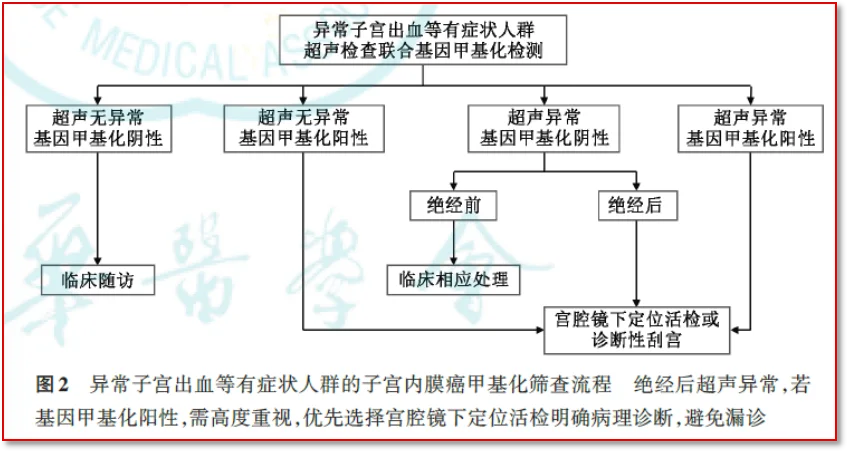
Figure 2 shows the clinical pathway for endometrial cancer methylation screening for symptomatic populations such as those with abnormal uterine bleeding (AUB). Its core logic is "ultrasound primary screening + methylation triage."
IV. Detailed Steps of the Pathway
(1) Step 1: Combined Testing and Triage
For patients with symptoms such as abnormal uterine bleeding, two parallel tests are performed first:
-
Ultrasound examination: assessing endometrial thickness and morphology.
-
Gene methylation testing (e.g., CISPOLY's noninvasive Hekou'an®): assessing whether malignant epigenetic features exist in the cells.
(2) Step 2: Four-Quadrant Decision Matrix
Based on the results of both tests, patients are assigned to four management pathways:
- Pathway 1: Normal ultrasound + methylation negative
(1). Management: Clinical follow-up.
(2). Interpretation: Dual low risk, endometrial cancer not considered for now, regular observation is sufficient.
- Pathway 2: Normal ultrasound + methylation positive
(1). Management: Hysteroscopic targeted biopsy or diagnostic curettage.
(2). Interpretation: Although ultrasound shows no obvious abnormality, positive methylation indicates abnormal epigenetic features. This may involve focal lesions or early changes, and further measures (such as hysteroscopy) should be determined based on clinical circumstances.
- Pathway 3: Abnormal ultrasound + methylation negative
(1). Management: Depends on menopausal status.
(a). Premenopausal: appropriate clinical management (caution is needed, as the combination of ultrasound abnormality in younger women with false-negative risk requires comprehensive judgment);
(b). Postmenopausal: histopathological confirmation is still required.
(2). Interpretation: Ultrasound abnormalities (such as thickened endometrium) in postmenopausal women carry a higher malignant risk by themselves; even with negative methylation, pathological confirmation is still needed to rule out false negatives.
- Pathway 4: Abnormal ultrasound + methylation positive
(1). Management: Hysteroscopic targeted biopsy or diagnostic curettage.
(2). Interpretation: Dual high risk with a high probability of malignancy. The consensus specifically emphasizes: "For postmenopausal women with abnormal ultrasound and positive methylation, high attention is required, and hysteroscopic targeted biopsy should be prioritized to confirm the pathological diagnosis and avoid missed diagnosis."
- Core Value of the Pathway
This pathway improves screening precision through methylation testing. In particular, for the "gray zone" population with "abnormal ultrasound but negative methylation" or "normal ultrasound but positive methylation," it provides a more refined triage strategy, reducing blind curettage or missed diagnosis.
Disclaimer: The above content is an interpretation based on the diagram information only and does not constitute medical diagnosis or treatment advice. Please follow the guidance of professional physicians for specific diagnosis and treatment plans.
V. CISPOLY Hekou'an® (CDO1/CELF4 Methylation) Detection Technology
CISPOLY's technology greatly optimizes the screening pathway for symptomatic populations. Through the dual noninvasive combination of "transvaginal ultrasound" + "Hekou'an® testing," symptomatic populations can capture early cancer signals without worrying about potential intrauterine injury risks from invasive procedures, truly realizing the personalized medicine concept of "screen when needed, screen with precision." This has milestone significance in global endometrial cancer screening guidelines.
The "italic text" and diagrams are cited from the expert consensus.
Source
Gynecologic Oncology Branch of the Chinese Medical Association, Professional Committee of Obstetrics and Gynecology of the Chinese Research Hospital Association, Maternal and Gynecologic Health Branch of the China International Exchange and Promotive Association for Medical and Health Care. Expert Consensus on Clinical Application of Endometrial Cancer Gene Methylation Screening Technology (2026 Edition). National Medical Journal of China, 2026, 106(26): 2701-2710. DOI: 10.3760/cma.j.cn112137-20260301-00576

Beijing Origin-Poly Co., Ltd. is a technology enterprise driven by innovation and dedicated to health. As a pioneer in early diagnosis of gynecologic tumors, CISPOLY has developed early-diagnosis products for cervical, endometrial, and ovarian cancers using proprietary technologies and patent-protected biomarkers, filling a gap in the field. As women pay increasing attention to their own health, the women's health market holds great potential. Beyond the gynecologic tumor early screening and early diagnosis product line, CISPOLY will continue to build more women's health-related product pipelines, establishing itself as a technology-innovative leading enterprise in the women's health market.