Guidelines/Consensus Noninvasive Endometrial Cancer Methylation Screening Clinical Pathway — Interpretation of the Expert Consensus on Clinical Application of Endometrial Cancer Gene Methylation Screening Technology: Methylation Screening Workflow (Series Report 4)
July 30, 2026, 10:15
– Endometrial cancer methylation screening workflow for populations at increased risk (obesity, metabolic syndrome, etc.) –
With changing lifestyles, obesity and metabolic syndrome have become hidden killers of women's health in China. These populations are exactly the "populations at increased risk" defined in the Expert Consensus on Clinical Application of Endometrial Cancer Gene Methylation Screening Technology (2026 Edition) (hereinafter "the Consensus"). For this large population that has not yet shown obvious symptoms, the Consensus defines a standardized screening pathway for the first time. As one of the first domestically approved NMPA Class III detection tools, Beijing Origin-Poly's "Hekou'an® (Human CDO1 and CELF4 Gene Methylation Detection Kit)" — with its noninvasive sampling and excellent performance — will become a key tool to resolve the conflict between "fear of cancer" and "over-treatment" for this population, in accordance with this expert consensus.
I. Population at Increased Risk: High-Risk Groups Hidden in Daily Life
The Consensus clearly states that the population at increased risk refers to those whose risk of endometrial cancer is significantly elevated due to non-genetic risk factors. These people often neglect examinations because they are asymptomatic, or refuse medical visits because they fear intrauterine procedures.
Risk factors defined by the Consensus include:
-
Obesity [body mass index (BMI) ≥ 28 kg/m²]: Endometrial cancer is the malignant tumor most strongly associated with obesity. For every 5 kg/m² increase in BMI, the risk of endometrial cancer increases by 60% (95% CI: 40%–60%).
-
Metabolic syndrome: Known insulin resistance, hyperinsulinemia, type 2 diabetes, and polycystic ovary syndrome (PCOS) promote endometrial hyperplasia by lowering levels of sex hormone-binding globulin and insulin-like growth factor 1 (IGF-1) binding protein. This increases the bioavailability of estrogen and IGF-1, leading to activation of the procarcinogenic PI3K-AKT-mTOR signaling pathway and thus endometrial proliferation. Given the high prevalence of these metabolic disorders among women, they should be regarded as important risk factors when selecting populations at risk for endometrial cancer.
-
Medication factors: Unopposed estrogen effects without progesterone antagonism, including functional ovarian tumors, postmenopausal estrogen replacement therapy alone, long-term tamoxifen therapy in breast cancer patients, and long-term use of mifepristone. Breast cancer survivors receiving tamoxifen have an increased risk of endometrial cancer. Tamoxifen is associated with an increased incidence of endometrial abnormalities, including hyperplasia, atypia, and malignancy. This increased incidence is dose- and duration-dependent.
-
Other factors: Advanced age, delayed menopause (>55 years) or early menarche (<12 years), as well as those with infertility (2-fold increased risk) or nulliparity.
II. Recommendations
For this population, the Consensus provides a clear annual management strategy, emphasizing a balance between "no missed diagnosis" and "no over-treatment":
-
Recommendation 7: For populations at increased risk, annual ultrasound examination is recommended to monitor endometrial thickness; patients with no ultrasound abnormalities may undergo clinical follow-up. (Strong recommendation)
-
Recommendation 8: Abnormal ultrasound findings require combined gene methylation testing; if methylation testing is positive, histopathological confirmation is required; if negative, postmenopausal patients still require histopathological confirmation, while premenopausal patients may receive symptomatic treatment followed by follow-up. (Recommendation)
III. Clinical Pathway Diagram
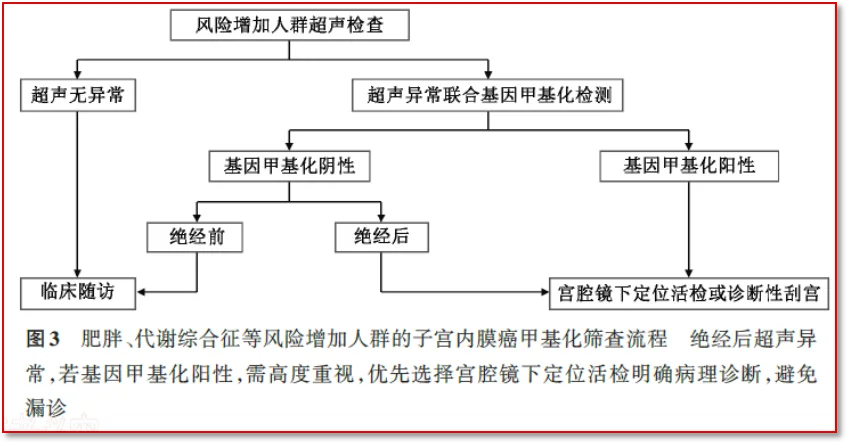
Figure 3 shows the endometrial cancer methylation screening management pathway for populations at increased risk such as those with obesity and metabolic syndrome. Unlike Figure 2 (for already symptomatic populations), Figure 3 targets asymptomatic populations with high-risk factors. Its core logic is: first perform low-cost, noninvasive ultrasound primary screening, and only when ultrasound reveals abnormalities introduce high-precision methylation testing for secondary triage — thereby maximizing reduction of the medical burden on high-risk populations while ensuring no missed diagnosis.
IV. Detailed Steps of the Pathway: How Figure 3 Achieves Precise Burden Reduction
The Figure 3 pathway in the Consensus is specifically designed for populations at increased risk such as those with obesity and metabolic syndrome. Its core logic is: first perform low-cost ultrasound primary screening, and only when ultrasound reveals abnormalities introduce high-precision methylation testing for secondary triage — thereby maximizing reduction of both medical burden and psychological stress on high-risk populations while ensuring no missed diagnosis.
(1) Step 1: Baseline Screening (Ultrasound)
All populations at increased risk should first undergo ultrasound examination to assess endometrial thickness and morphology. If ultrasound shows no abnormality, only clinical follow-up is needed, without excessive anxiety.
(2) Step 2: Two Major Pathways Based on Ultrasound Results
- Pathway 1: Normal ultrasound
(1). Management: Clinical follow-up.
(2). Interpretation: The endometrium appears normal on imaging. Since these populations remain at long-term high risk, regular ultrasound re-examination is recommended to dynamically monitor risk changes.
- Pathway 2: Abnormal ultrasound (e.g., thickened endometrium, heterogeneous echoes)
(1). Management: Combined gene methylation testing.
A. Methylation negative
(A). Premenopausal women: Clinical follow-up is generally recommended. Younger women have more physiological endometrial changes; negative methylation indicates lower malignant risk, and invasive procedures may be deferred.
(B). Postmenopausal women: Hysteroscopic targeted biopsy or diagnostic curettage is recommended. Because the endometrium of postmenopausal women should normally be atrophic, ultrasound abnormalities themselves carry higher malignant risk; even with negative methylation, pathological confirmation is still required to rule out false negatives.
B. Methylation positive
(A). Management: Hysteroscopic targeted biopsy or diagnostic curettage.
(B). Interpretation: Abnormal ultrasound combined with positive methylation indicates extremely high lesion risk. The Consensus emphasizes: "For postmenopausal women with abnormal ultrasound and positive methylation, high attention is required, and hysteroscopic targeted biopsy should be prioritized to confirm the pathological diagnosis and avoid missed diagnosis."
(2). Interpretation: Abnormal ultrasound is a warning sign, but since benign diseases (such as polyps or simple hyperplasia) may also cause ultrasound abnormalities, directly performing invasive biopsy at this point can easily lead to "over-treatment." Introducing methylation testing can further assess molecular-level risk.
Disclaimer: The above content is an interpretation based on the diagram information only and does not constitute medical diagnosis or treatment advice. Please follow the guidance of professional physicians for specific diagnosis and treatment plans.
V. Core Value of Hekou'an® in the Pathway
-
Sampling advantage, solving the "difficult sampling" pain point: Obese and postmenopausal women often have cervical atrophy and thin endometrium; traditional diagnostic curettage or micro-tissue biopsy is difficult and has high failure rates. Hekou'an® uses cervical exfoliated cell sampling (consistent with HPV testing), completely unaffected by endometrial thickness, with a sampling success rate close to 100%.
-
Precise triage, ending "cancer-phobia" anxiety: For premenopausal patients with abnormal ultrasound but negative methylation, Hekou'an®'s high specificity can effectively reassure patients and avoid unnecessary surgical intervention.
-
Optimal health economics: Ultrasound primary screening filters out most low-risk individuals, and Hekou'an® testing is used only for high-risk suspicious populations — ensuring screening precision while conforming to the principle of rational allocation of medical resources.
VI. Conclusion
For the hundreds of millions of women with obesity and metabolic syndrome, the establishment of the Figure 3 pathway in the Consensus has milestone significance. It is not just a screening workflow; it is a form of humanistic care.

Beijing Origin-Poly Co., Ltd. is a technology enterprise driven by innovation and dedicated to health. As a pioneer in early diagnosis of gynecologic tumors, CISPOLY has developed early-diagnosis products for cervical, endometrial, and ovarian cancers using proprietary technologies and patent-protected biomarkers, filling a gap in the field. As women pay increasing attention to their own health, the women's health market holds great potential. Beyond the gynecologic tumor early screening and early diagnosis product line, CISPOLY will continue to build more women's health-related product pipelines, establishing itself as a technology-innovative leading enterprise in the women's health market.