Conference Notes: China Cervical Cancer Prevention Project — 2025 HPV Infection Prevention Conference: Non-Invasive Cervical Cancer Methylation Testing Builds a 'Molecular Defense Line' for Women's Health
On September 13, 2025, the China Cervical Cancer Prevention and Control Project — 2025 HPV Infection Prevention and Treatment Congress, organized by the China Cervical Cancer Prevention and Control Project Committee, hosted by Henan Provincial People's Hospital, and co-organized by Beijing PETE Biological Group, was successfully held in Zhengzhou. Experts and scholars from across the country attended this grand event. With the theme "Effective Prevention and Treatment of HPV Infection and Related Diseases," the congress highlighted the characteristics of "interdisciplinary · multi-domain · empowering clinical practice," divided into four major thematic lecture tracks — research progress, guidelines/consensus, intraepithelial lesions, and co-treatment of men and women — and case competitions, jointly exploring the latest advances in HPV infection prevention and treatment.

Professor Cao Zeyi of the China Cervical Cancer Prevention and Control Project Committee delivered opening remarks, noting that great achievements have been made in cervical cancer prevention and treatment over the years. For the 2030 milestone targets of "90-70-90" proposed in the Global Strategy to Accelerate the Elimination of Cervical Cancer, the task remains arduous, but he firmly believes that with everyone's joint efforts, the mission of nationwide elimination of cervical cancer will certainly be achieved by 2050.

Professor Wang Yue pointed out that cervical cancer prevention and treatment has captured the dedication of generations of obstetricians and gynecologists. From vaccine popularization to innovations in detection and medical testing technology, and the refinement of expert consensus and guidelines, an important barrier against cervical cancer has been built for women's health.

In the field of cervical cancer prevention and treatment, the congress particularly emphasized the importance of fertility preservation. As a high-risk condition among HPV-related diseases, traditional cervical cancer treatment may affect women's reproductive health. During the conference, experts shared how fertility preservation strategies can be integrated into surgical, radiation, and other interventions — for example, through minimally invasive techniques and individualized protocols that reduce damage to the ovaries and uterus, ensuring patients' post-treatment quality of life. Meanwhile, precision medicine principles were emphasized throughout, including personalized screening and treatment based on genotyping and molecular biomarkers to improve prevention and treatment efficiency.
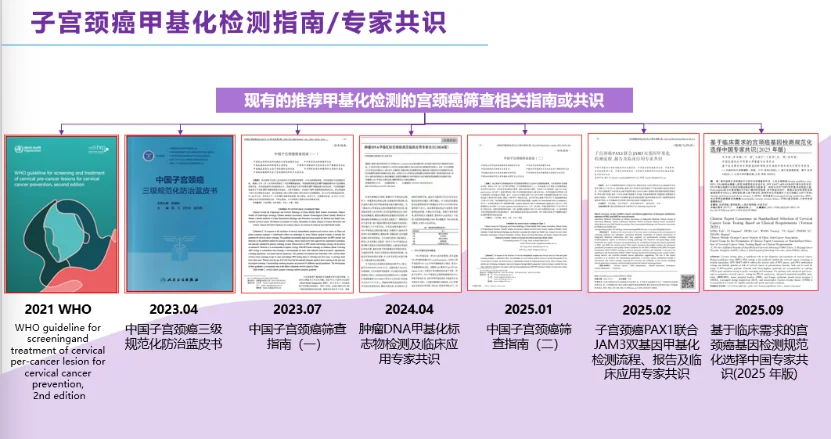
Notably, the key role of methylation detection in early diagnosis of cervical cancer became a focus. As an important component of precision medicine, DNA methylation biomarkers (such as PAX1, JAM3, etc.) can effectively identify precancerous lesions of HPV infection, improve screening accuracy, reduce false positives, and multiple guidelines and consensus documents have been issued to help healthcare workers achieve early diagnosis and treatment, reducing cervical cancer incidence risk.
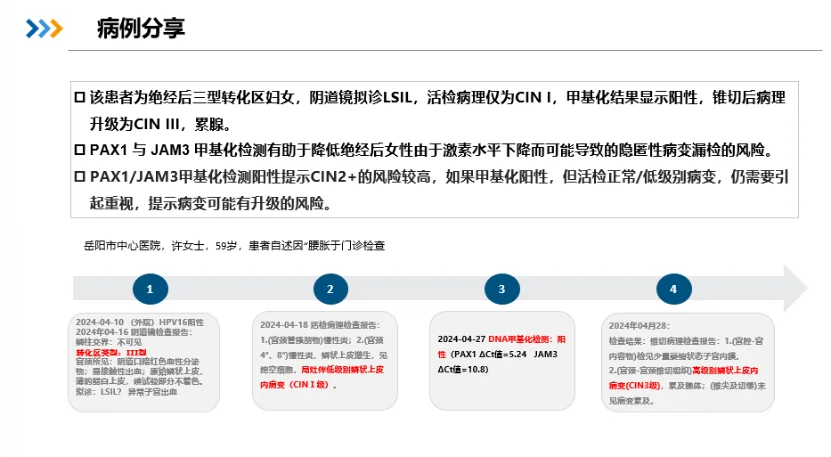
Case sharing also demonstrated that PAX1/JAM3 dual-gene methylation detection can identify CIN3 high risk in postmenopausal women with Type 3 transformation zones and serve as an important biomarker for subsequent follow-up.
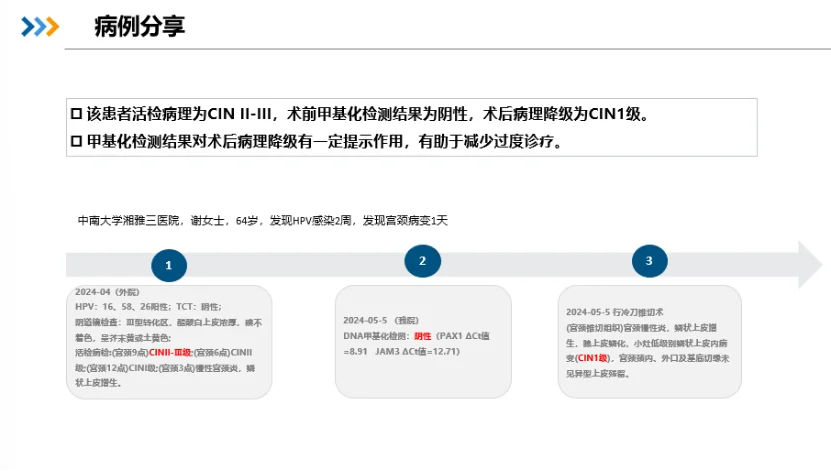
PAX1/JAM3 dual-gene methylation detection technology, by capturing abnormal DNA methylation signals in cervical cells, can achieve early precision screening for cervical precancerous lesions (CIN2+) and cervical cancer. Clinical data show that this detection has high sensitivity and specificity for CIN2+, can simultaneously cover both squamous cell carcinoma and adenocarcinoma detection, and significantly outperforms traditional cytology examination. In treatment follow-up, its predictive accuracy for post-conization recurrence risk (AUC>0.92) has become a clinical management tool, helping to achieve a "early screening – precision treatment – dynamic monitoring" closed-loop prevention and control system. This technology has been incorporated into multiple Cervical Cancer Expert Consensus documents, building a "molecular defense line" for women's health.

Beijing Origin CISPOLY Biotechnology Co., Ltd. is a technology enterprise driven by innovative science and focused on health. CISPOLY is a pioneer in the field of early diagnosis of gynecologic tumors. With proprietary technology and patent-protected biomarkers at its core, the company has developed early diagnostic products for cervical cancer, endometrial cancer, ovarian cancer, and other gynecologic tumors, filling a void in this field.
As women pay increasing attention to their own health, the women's health market holds great promise. Beyond its gynecologic tumor early screening and diagnosis product line, CISPOLY will continue to build additional women's health-related product pipelines, striving to become a technology-innovation-driven leader in the women's health market.