China's Self-Sampling Cervical Cancer Methylation Research Gains International Recognition; Swedish Experts Look Forward to Deeper Collaboration — Showcasing Self-Sampling Methylation Results Globally at IPVC 2025

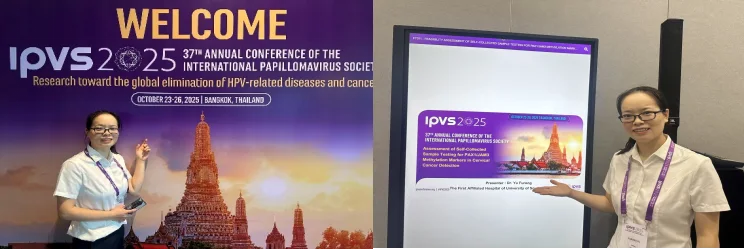
From October 23 to 26, 2025, the 37th International Papillomavirus Society Conference (IPVC 2025) was grandly held in Bangkok, Thailand. Dr. Yu Furong from the First Affiliated Hospital of University of South China, as one of China's representatives, presented at the E-poster Flash Talk session the collaborative study between the First Affiliated Hospital of University of South China and the Zeng Fei team at the Third Xiangya Hospital: "FTO11-FEASIBILITY ASSESSMENT OF SELF-COLLECTED SAMPLE TESTING FOR PAX1/JAM3 METHYLATION MARKERS IN CERVICAL CANCER DETECTION (ID 785); Feasibility Assessment of Self-Collected Sample Testing for PAX1/JAM3 Methylation Markers in Cervical Cancer Detection."
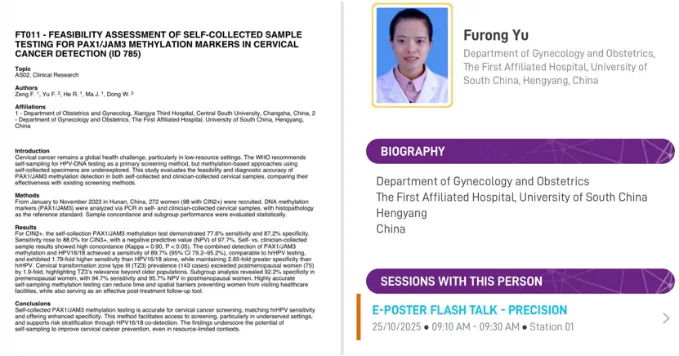
This research finding systematically confirmed for the first time that self-sampled PAX1/JAM3 methylation detection has high concordance with physician-collected sample results, providing an innovative solution for improving cervical cancer screening accessibility. Dr. Yu Furong's presentation attracted attention from experts across multiple countries and became one of the conference highlights.
1. China's Voice on the International Stage
This study enrolled 272 women undergoing colposcopy, validating the reliability of self-sampling technology through rigorous experimental design.
Study Data
-
PAX1 and JAM3 dual-gene methylation detection results from self-collected and physician-collected samples showed significant positive correlation, with correlation coefficients reaching 0.858 and 0.828, respectively. This finding provides solid evidence for the promotion and application of self-sampling technology in cervical cancer screening.
-
Self-sampled PAX1/JAM3 methylation detection achieved sensitivity of 77.6% and specificity of 87.2% for CIN2+ lesions, demonstrating excellent clinical detection performance.
-
Particularly noteworthy, PAX1/JAM3 methylation combined with HPV16/18 detection achieved sensitivity of 96.0% for CIN3+ lesions, significantly outperforming traditional detection methods. This finding is of great significance for improving the detection rate of high-grade lesions.
-
This detection technology performed well in both premenopausal and postmenopausal women. In postmenopausal women, detection sensitivity and negative predictive value reached 94.7% and 95.7%, respectively, providing new ideas for solving the challenge of cervical cancer screening in postmenopausal women.
Addressing Cervical Cancer Screening Pain Points
-
Dr. Yu Furong noted in her presentation that self-sampling technology can effectively overcome many barriers in traditional screening. Particularly for women in areas with insufficient medical resources, those with limited mobility, or those unwilling to visit clinics for personal reasons, self-sampling provides a more convenient screening option.
-
Study data show that the specificity of PAX1/JAM3 methylation detection is significantly higher than hrHPV testing, meaning that false-positive results can be substantially reduced, avoiding unnecessary colposcopy referrals and psychological burden.
This technology also helps address the screening challenge for women with Type 3 transformation zones (TZ3). The number of TZ3 women in the study was 1.9 times that of postmenopausal women, indicating that this issue also exists among reproductive-age women, and methylation detection provides an effective solution.
2. High Praise from International Experts
During the IPVC conference, Dr. Yu Furong's research presentation sparked extensive discussion among international peers.
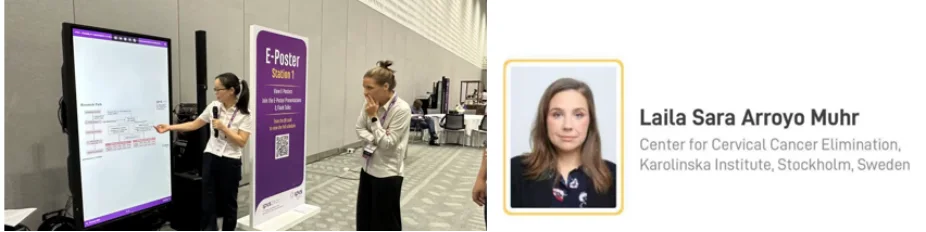
Dr. Muhr, head of the Cervical Cancer Elimination Center at Sweden's Karolinska Institute and the International HPV Reference Center, stated after hearing Dr. Yu Furong's poster presentation: "This study has made important breakthroughs in combining self-sampling technology with methylation detection. The high sensitivity in postmenopausal women and high specificity in reproductive-age women contribute Chinese wisdom and Chinese solutions to the global goal of cervical cancer elimination."
The promotion of this technology will particularly benefit women in remote and economically underdeveloped areas, powerfully advancing the popularization of cervical cancer screening and providing strong technological support for achieving health equity.
3. Background Information
Karolinska Institute is located in Stockholm, the capital of Sweden. It is a renowned Swedish medical school, one of the world's largest and best single medical schools, and ranks among the world's top ten medical schools. It undertakes 43% of the nation's pharmaceutical academic research and has an affiliated Karolinska University Hospital. The institute is world-famous for its Nobel Committee, which is responsible for reviewing and awarding the Nobel Prize in Physiology or Medicine each year.
Dr. Laila Sara Arroyo Muhr, as an expert at the Cervical Cancer Elimination Center of the Karolinska Institute, is an internationally recognized authority in the field of HPV and cervical cancer prevention. She currently serves as the scientific director of the International Human Papillomavirus Reference Center, responsible for coordinating the Global HPV Laboratory Network (Global HPV LabNet).

Beijing Origin CISPOLY Biotechnology Co., Ltd. is a technology enterprise driven by innovative science and focused on health. CISPOLY is a pioneer in the field of early diagnosis of gynecologic tumors. With proprietary technology and patent-protected biomarkers at its core, the company has developed early diagnostic products for cervical cancer, endometrial cancer, ovarian cancer, and other gynecologic tumors, filling a void in this field.
As women pay increasing attention to their own health, the women's health market holds great promise. Beyond its gynecologic tumor early screening and diagnosis product line, CISPOLY will continue to build additional women's health-related product pipelines, striving to become a technology-innovation-driven leader in the women's health market.