HPV Epidemiology and PAX1/JAM3 Methylation in Cervical Cancer Screening: A Study of 52,605 Women in Changshu
September 24, 2026, 14:55 (China Standard Time)
A study published in Scientific Reports describes high-risk human papillomavirus (hrHPV) infection in a screening population in Changshu, China. In a subgroup of 173 women undergoing further assessment, it evaluates the diagnostic value of PAX1/JAM3 methylation, providing research evidence for cervical cancer screening and triage of HPV-positive women.
I. Background and objectives
Persistent hrHPV infection is a key factor in the development of high-grade cervical intraepithelial lesions and cervical cancer. HPV testing is widely used in screening, but a positive result alone does not reliably distinguish transient infection from persistent infection associated with lesion progression, potentially increasing unnecessary colposcopy and clinical intervention. The relationship between HPV viral load and lesion severity also remains unsettled.
DNA methylation is an important epigenetic alteration in cervical carcinogenesis. Previous studies suggest that PAX1 and JAM3 methylation increases with lesion severity and may provide additional information for identifying high-grade lesions. This study examined:
- HPV prevalence, dominant genotypes, and age and geographical distributions among women aged 30–65 in Changshu.
- PAX1/JAM3 methylation across cervical lesion grades and its diagnostic performance.
- Correlations between methylation and HPV viral load.
- Independent associations between methylation and CIN2+ and its potential value for risk stratification.
II. Methods
From March to August 2024, the study recruited 52,605 women aged 30–65 in Changshu and collected exfoliated cervical cells. All participants provided informed consent, and the study received approval from the biomedical ethics committee of the Changshu medical testing institute.
The SLAN-96 S PCR system was used to detect 14 hrHPV genotypes: 16, 18, 31, 33, 35, 39, 45, 51, 52, 56, 58, 59, 66, and 68. A subgroup of 173 HPV-positive women was selected by age and geographical strata for histopathological assessment, HPV viral load quantification, and methylation-specific qPCR for PAX1 and JAM3. GAPDH served as the reference gene. Methylation was expressed as ΔCt: a lower ΔCt indicates higher methylation.
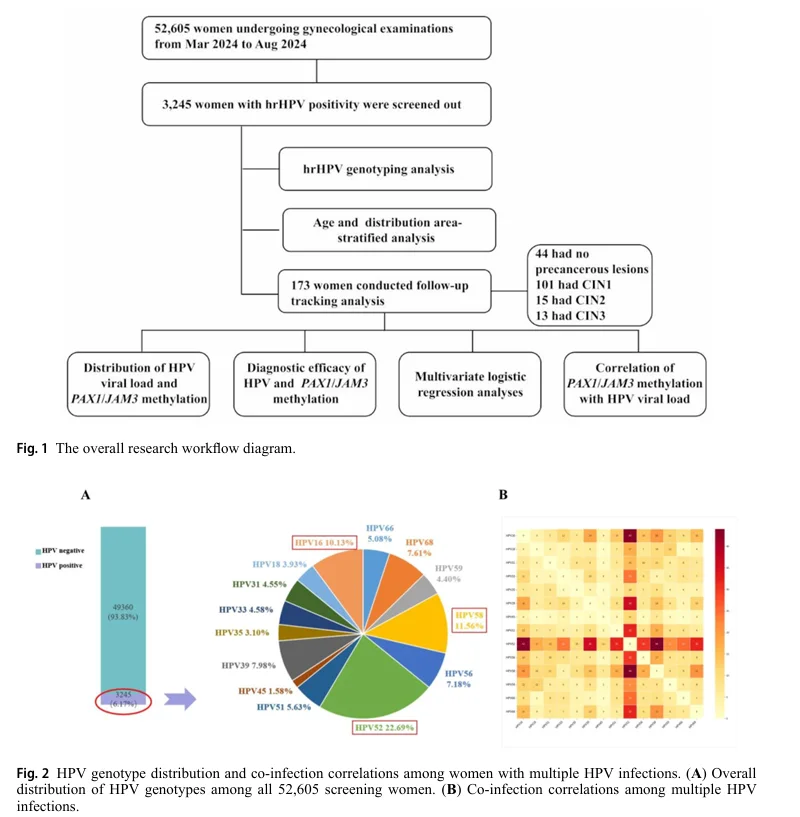
Statistical analyses used GraphPad Prism 10.0, SPSS 22.0, and R, including chi-square tests, rank-sum tests or analysis of variance, Pearson/Spearman correlation analyses, ROC curves, and binary logistic regression. A weighted composite methylation score was constructed using univariable regression β coefficients.
III. Results
1. Epidemiological features of HPV infection
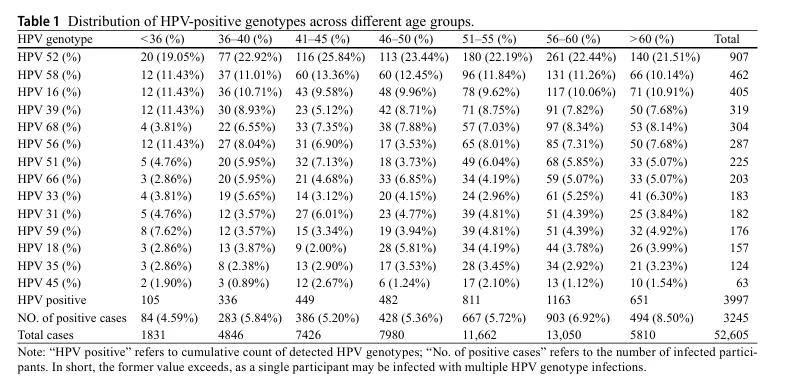
Overall HPV positivity was 6.17% (3,245/52,605), with 3,997 genotype detections. HPV52 (22.69%), HPV58 (11.56%), and HPV16 (10.13%) predominated, followed by HPV39 (7.98%), HPV68 (7.61%), and HPV56 (7.18%); HPV18 accounted for 3.93%. These percentages refer to genotype detections, rather than genotype-specific prevalence among all screened women.
Single-genotype infections accounted for 81.23% of HPV-positive women (2,636), while multiple infections accounted for 18.77% (609). There were 489 dual infections, most commonly HPV52+58; 100 triple infections; and 20 infections involving four or more genotypes.
Overall prevalence increased significantly with age (χ²=101.3, P<0.0001), reaching its highest level of 8.50% among women over 60. Single infections followed the overall trend. Dual infections were least frequent at ages 46–50 and most frequent over 60; triple infections showed a U-shaped pattern, while infections involving four or more genotypes increased after age 56.
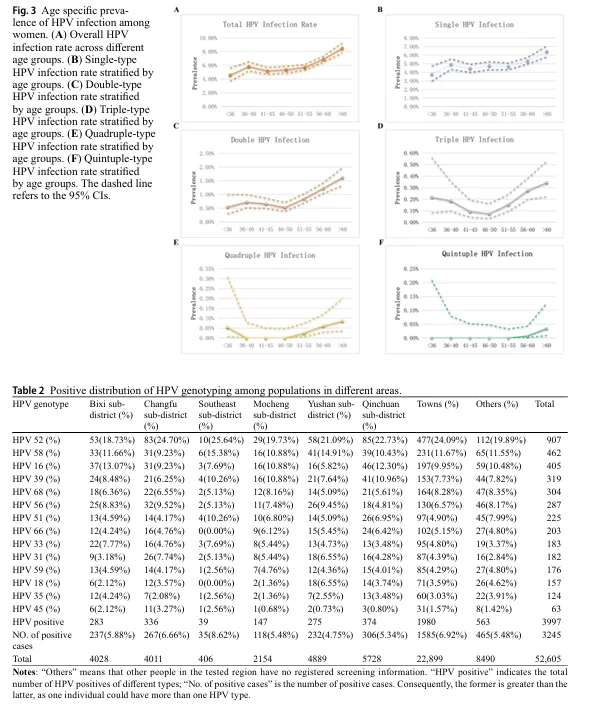
Prevalence varied between districts from 4.75% to 8.62% (χ²=61.53, P<0.0001), with the highest rate in Dongnan and the lowest in Yushan. Genotype distributions also differed: HPV52 represented 25.64% and 24.70% of genotype detections in Dongnan and Changfu, respectively; HPV16 represented 13.07% in Bixi and 5.82% in Yushan; HPV18 accounted for 6.55% in Yushan and was not detected in Dongnan.
2. Lesion grade, methylation, and viral load
Histopathology in the 173-woman subgroup showed 44 normal findings, 101 CIN1 cases, 15 CIN2 cases, and 13 CIN3 cases. Viral load did not differ significantly across lesion grades for overall HPV, HPV16/18, or non-16/18 types.
PAX1 and JAM3 ΔCt values decreased stepwise as lesion severity increased, indicating increasing methylation (both P<0.0001). Methylation in CIN3 was significantly higher than in normal findings and CIN1. PAX1 and JAM3 methylation levels were positively correlated (R=0.519, P<0.0001), but neither showed a significant correlation with HPV viral load.
3. Diagnostic performance and multivariable analysis
The source article reports that combined PAX1/JAM3 methylation testing outperformed HPV16/18 genotyping for identifying high-grade lesions such as CIN3. Overall performance was comparable for lower-grade lesions, with methylation testing showing higher sensitivity for CIN1 and higher specificity for CIN2.
After age adjustment, the weighted composite methylation score was independently associated with CIN2+: adjusted OR=1.965 (95% CI: 1.520–2.541, P<0.001). Each one-unit increase in the score was associated with a 96.5% increase in the odds of CIN2+; this odds ratio does not directly mean a 96.5% increase in disease probability. Age showed a modest inverse association with CIN2+ (adjusted OR=0.933, P=0.022). The Hosmer–Lemeshow test did not indicate significant lack of fit (P=0.347).
IV. Discussion and limitations
HPV52, HPV58, and HPV16 predominated, consistent with findings from some other areas of eastern China. Geographical differences support consideration of local infection patterns in screening and prevention. Higher prevalence among women over 60 also highlights the continuing relevance of screening in older women. The source discusses screening coverage, vaccination, lifestyle, and postmenopausal changes in immunity, hormones, and vaginal microbiota as possible influences; these explanations should not be interpreted as causal findings established by this study.
The study found no clear association between viral load and lesion severity. Infection duration, sampling time and lesion location, and the small number of high-grade lesions may have influenced the results. PAX1/JAM3 methylation may provide stratification information relatively distinct from current viral replication, although a lack of observed correlation does not establish complete independence.
The source discusses how persistent HPV infection and viral DNA integration may accompany epigenetic changes. Promoter hypermethylation of PAX1 and JAM3 and suppression of gene expression may contribute to abnormal proliferation and invasion. These are proposed mechanisms, rather than causal relationships directly established by this study.
The cross-sectional design cannot establish the temporal sequence or causality between infection, methylation changes, and lesion progression, or describe changes in these markers over time. Women under 30 were not included. The subgroup contained only 15 CIN2 and 13 CIN3 cases, potentially limiting the statistical power of some comparisons and association analyses.
V. Conclusions
Screening data from 52,605 women aged 30–65 describe age and geographical differences in HPV infection in Changshu. In the 173-woman subgroup, PAX1/JAM3 methylation increased with lesion severity and was independently associated with CIN2+, suggesting potential as an adjunctive triage marker for women with positive primary HPV screening results.
These findings provide research evidence for improving cervical cancer screening. Results should be interpreted alongside HPV genotyping, cytology, colposcopy, and histopathology and cannot independently replace clinical or pathological diagnosis.
Reference
Xu, Y., Chen, H., Guo, T. et al. HPV epidemiology and PAX1/JAM3 methylation in cervical cancer screening. Scientific Reports (2026). DOI: 10.1038/s41598-026-71236-4
Original article

Beijing OriginPoly Bio-Tec Co., Ltd. is a technology company driven by innovation and dedicated to health. CISPOLY focuses on the early diagnosis of gynecological cancers and develops products for cervical, endometrial, and ovarian cancer based on proprietary technologies and patent-protected biomarkers.
CISPOLY will continue to advance early screening and diagnosis products for gynecological cancers and develop additional women's health product pipelines, supporting women's health through continued technological innovation.