Cervical Cancer Screening Achieves a Precision Breakthrough: JAM3 and PAX1 Gene Methylation Testing Overcomes Current Clinical Diagnostic Limitations
An innovative study led by Chengdu Fifth People's Hospital has brought major advances to the field of cervical cancer screening. The study found that by detecting the methylation levels of the JAM3 and PAX1 genes, the clinical diagnostic bias inherent in traditional biopsy methods can be effectively resolved. Published in the journal Scierxiv, these findings mark a new stage in early diagnosis and treatment of cervical cancer.
1. Clinical Diagnostic Dilemma: Limitations of Biopsy Technology
The current cervical cancer diagnostic system has notable shortcomings. Research data show that approximately 20-30% of patients face the dilemma of "clinical-pathological discrepancy" — patients' clinical presentations suggest high-grade lesions, but biopsy results show low-grade lesions or normal pathology.
Root cause analysis:
-
Anatomical constraints: Approximately 35% of lesions are located deep within the endocervical canal, beyond the reach of traditional biopsy instruments.
-
Sampling bias: Even with visible lesions, sampling position deviations can affect pathological judgment accuracy.
-
Diagnostic blind spots: Normal surface tissue cannot exclude the possibility of deep or occult precancerous lesions.
2. Technological Innovation: Advantages of Dual-Gene Detection
This detection technology has currently received NMPA Class III medical device certification. The study found through prospective analysis:
-
Lesion severity prediction: JAM3 and PAX1 gene methylation levels increase synchronously with lesion severity.
-
HPV correlation: In HPV16/18-infected patients, the gene methylation positivity rate reaches 87.5%.
-
Diagnostic accuracy: Dual-gene combined detection sensitivity reaches 88.76%, specificity 93.22%.
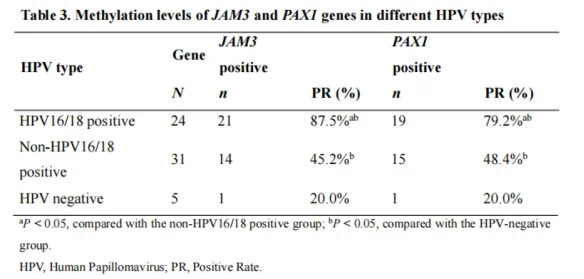
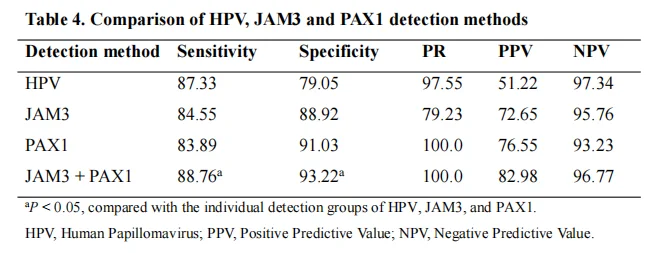
"This means that JAM3/PAX1 dual-gene methylation detection can identify high-risk patients earlier and more accurately in a non-invasive manner, equivalent to a non-invasive molecular pathology diagnostic method consistent with surgical pathology results."
The research team pioneered a new approach using non-invasive cervical exfoliated cell brushing for JAM3 and PAX1 gene methylation detection. This method overcomes the limitations of traditional biopsy, providing more reliable diagnostic evidence at the molecular level. Positive results can assist colposcopists in paying closer attention to possible lesions in occult areas of the cervix.
3. Study Summary and Core Value
Based on clinical application research of JAM3 and PAX1 gene methylation detection, the following screening optimization strategies are proposed to achieve precise stratified management for different populations:
1.Precise triage of HPV-positive populations
Integrating methylation detection into HPV-positive populations can establish an efficient three-level screening triage system. Clinical data show that this strategy can reduce unnecessary colposcopy biopsies by over 30%, significantly lowering medical resource consumption and patient economic burden. Methylation detection as a secondary triage tool effectively identifies truly high-risk populations, avoiding overtreatment.
2.Individualized management plans for special populations
(1). Clinical challenges for postmenopausal women: Due to cervical atrophy, the proportion of "unsatisfactory colposcopy" is as high as 40-60% (inability to clearly observe the squamocolumnar junction). For this challenge, methylation detection provides an innovative solution:
-
Methylation-positive patients: Initiate close follow-up mechanisms, performing combined testing every 3-6 months, supplemented with endocervical curettage and other further examinations when necessary
-
Methylation-negative patients: Screening intervals can be appropriately extended, reducing the frequency of medical intervention
(2). Management of reproductive-age women reflects precision medicine principles:
-
CIN2 lesions with negative methylation: Based on full physician-patient communication, observation or minimally invasive intervention options can be chosen
-
This strategy effectively balances disease risk with fertility preservation needs
(3). Feasibility of promotion in primary healthcare
The non-invasive nature, simple sample collection, standardized detection, and strong accessibility (improving cervical cancer screening coverage in remote areas) of methylation detection lay the foundation for its promotion in primary hospitals.
4. Expert Opinion
This study upgrades JAM3/PAX1 gene methylation detection from an HPV stratification management tool to a high-grade lesion prediction management model, representing an important step toward precision medicine for cervical cancer.
This innovative detection method is expected to be incorporated into the cervical cancer screening system, providing clinicians with a more precise diagnostic tool, ultimately benefiting the health of women worldwide.
Literature Source:
Xu S, Pan Z, Chen R, et al. JAM3 and PAX1 methylation as biomarkers in cervical cancer and precancer. Scierxiv 2025.

Beijing Origin CISPOLY Biotechnology Co., Ltd. is a technology enterprise driven by innovative science and focused on health. CISPOLY is a pioneer in the field of early diagnosis of gynecologic tumors. With proprietary technology and patent-protected biomarkers at its core, the company has developed early diagnostic products for cervical cancer, endometrial cancer, ovarian cancer, and other gynecologic tumors, filling a void in this field.
As women pay increasing attention to their own health, the women's health market holds great promise. Beyond its gynecologic tumor early screening and diagnosis product line, CISPOLY will continue to build additional women's health-related product pipelines, striving to become a technology-innovation-driven leader in the women's health market.